Категории
High wind events — from derechos and straight-line winds to tornado-adjacent gusts and winter windstorms — knock out power, tear off roofing, send debris flying, and trap families in damaged homes. Relief organizations staging high wind emergency supplies before the season hits can deploy shelter, water, and PPE within hours, not days. This guide covers what frontline crews actually need, what to stock in bulk, and how to avoid the mistakes that delay response.
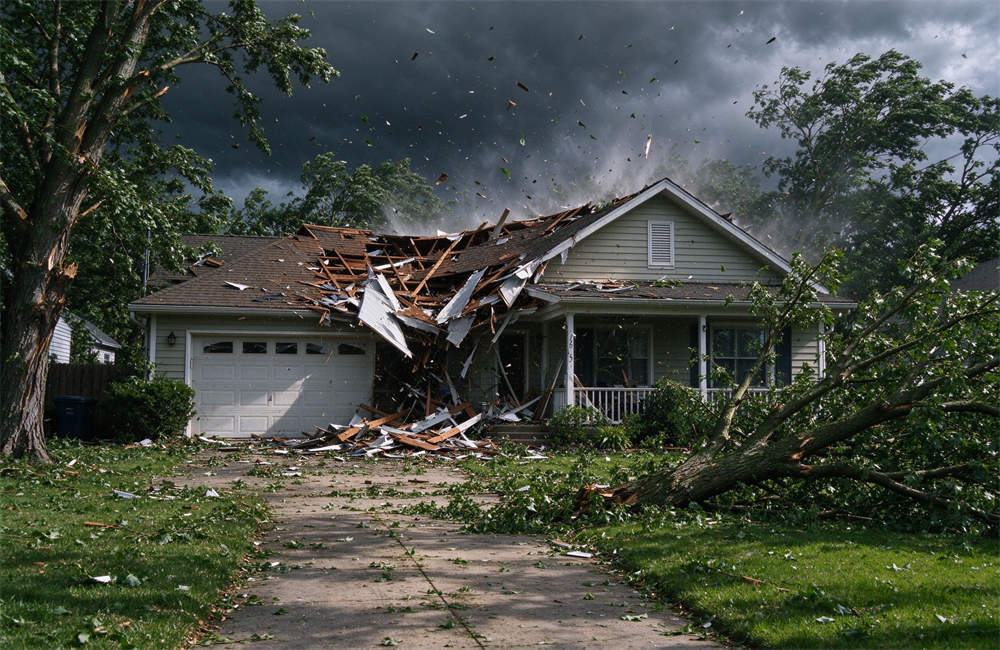
High wind event: roof torn off, debris everywhere.
Most jurisdictions treat high wind as a secondary hazard — something that happens alongside hurricanes, thunderstorms, or blizzards. But standalone straight-line wind events, derechos, and severe gust front events cause billions in damage every year, and they arrive with little warning. Relief teams that wait until the National Weather Service issues a warning are already behind: supplies need to be staged, staff need to be trained, and agreements need to be in place before the wind picks up.
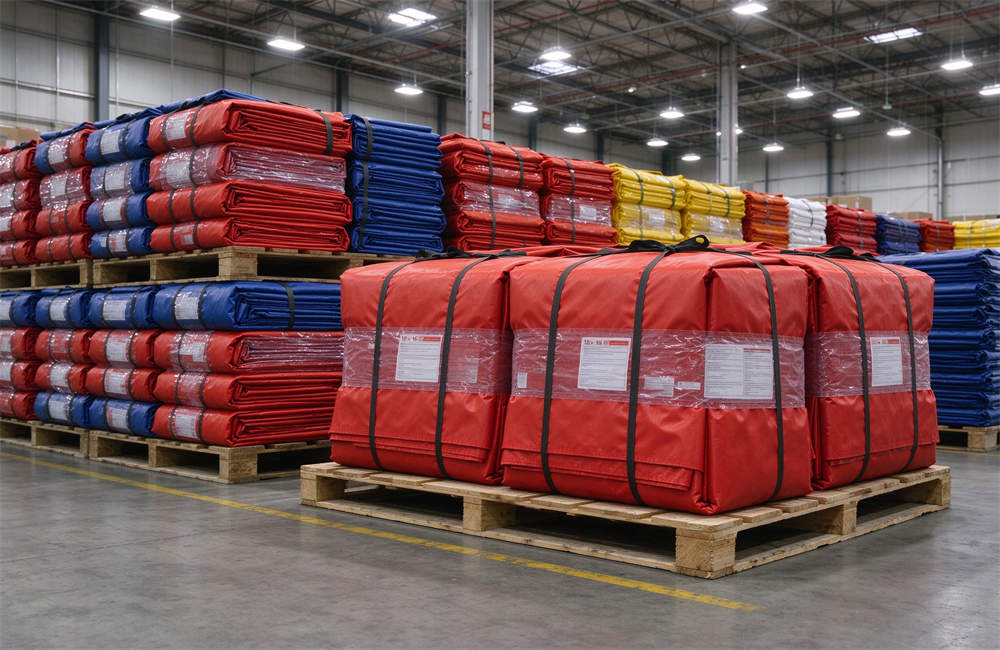
Bulk emergency tarps on pallets, ready for dispatch.
The biggest mistake organizations make is buying bulk emergency supplies that look good on a budget line but don't match what crews actually need in the field. Waterproof tarps, work gloves, headlamps, and water storage matter far more than fancy multi-tools or branded first-aid kits. Below, we break down the actual gear list, the quantities that make sense for different-sized responses, and how to work with a supplier that can deliver when you need it.
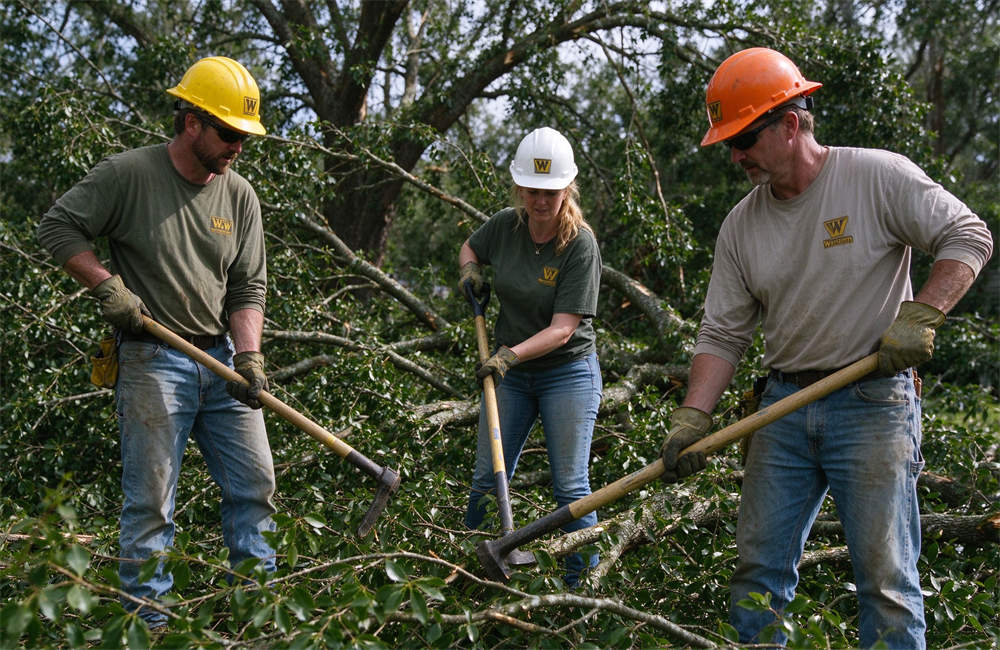
Volunteers in EN397 hard hats clearing fallen trees.
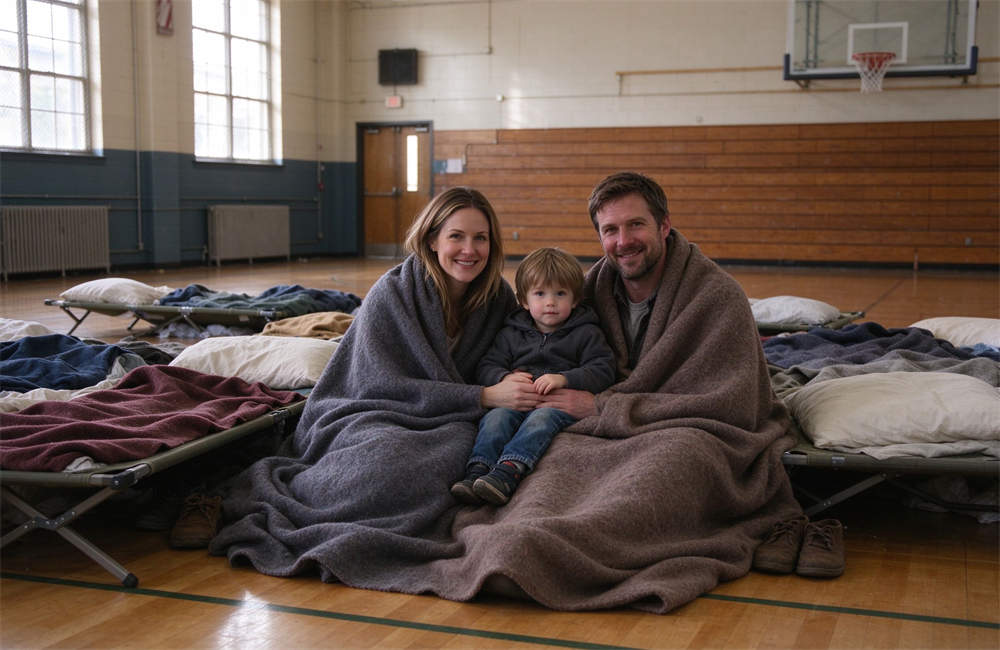
Family in shelter, covered with emergency wool blankets.
High wind events are the most under-prepared natural hazard in the United States. The National Weather Service estimates that straight-line wind damage accounts for more insured property loss each year than tornadoes, yet most emergency stockpiles are built around earthquakes and hurricanes. The CDC wind-related injury guide notes that flying debris and downed trees are the leading causes of wind-event injuries. When a derecho sweeps across several states overnight, the local supply chain is the first thing that fails — grocery stores run out of water, hardware stores sell out of tarps, and hotels are booked within hours.
For relief organizations, that gap is where you earn trust. When you show up within 24 hours with disaster relief equipment wholesale — tarps on a pallet, water bladders deployed, gloves on hand — you're not just handing out supplies. You're telling families who just had their roof torn off that someone is ahead of the curve, not scrambling behind it.
The FEMA National Preparedness Report finds that jurisdictions with pre-positioned shelter and tarp supplies recover 30–40% faster after wind events. The first 72 hours are chaotic — crews cutting trees, utilities repairing lines, families sleeping in cars. If you can drop a pallet of tarps at the fire station on day one, you've shortened the recovery window by days.
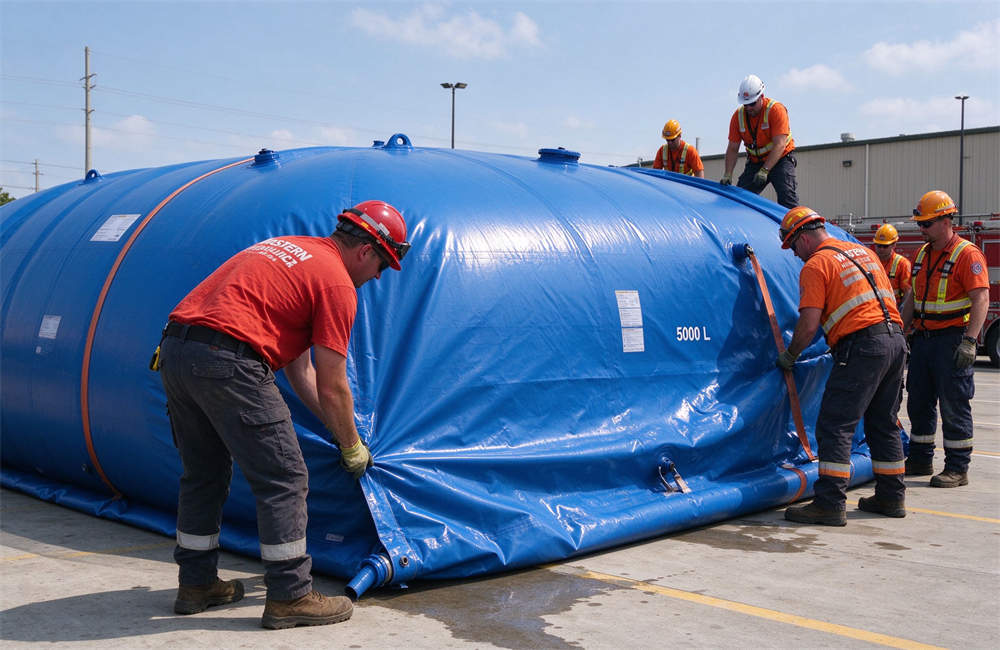
5000L foldable water bladder deployed in parking lot.
High wind isn't just "it's a bit breezy." Severe wind events — defined by the NWS as sustained gusts above 58 mph — bring a specific set of hazards that your supply list needs to match:
|
Hazard |
What It Looks Like |
Supplies You Need |
|
Roof and siding damage |
Shingles torn off, siding peeled away, leaks into attic |
12×16 ft tarps, duct tape, work gloves, pry bars |
|
Downed trees and power lines |
Trees across driveways, live wires on ground |
Chainsaws, hard hats, safety vests, barrier tape |
|
Extended power outages |
3–10 days without electricity, heat, or refrigeration |
Generators, light towers, cooling towels, bottled water |
|
Broken windows and flying debris |
Glass shattered, siding nails through walls |
Plywood sheeting, work gloves, safety goggles |
|
Shelter displacement |
Families evacuated because roof is gone or structure is unsafe |
Cots, blankets, hygiene kits, water storage |
Notice what's not on this list: fancy emergency food rations, gas masks, or HazMat suits. Those matter for other disasters, but for wind storm relief equipment, 80% of what crews do is cover roofs, clear debris, and keep families warm and hydrated. Your stockpile should reflect that.
Not all wind events are the same, and your response gear needs to match the type of wind you're dealing with. The National Weather Service distinguishes three main categories:
Type
Wind Speed
Duration
Damage Pattern
What You Need
Straight-line wind
58–75 mph gusts
Minutes
Uniform direction, shingles off, fences down
Tarps, gloves, hand tools
Derecho
75–100+ mph, 240+ mile swath
Hours, moves like a line
Widespread, thousands of downed trees, power out for days
Pallet tarps, chainsaws, water bladders, generators
Tornado-adjacent gust front
60–80 mph, narrow path
Seconds–minutes
Random structural damage, roof loss, debris scattered
Tarps, PPE, shelter cots, debris clearance
A derecho is the worst case for storm debris clearance tools and supply planning: it covers multiple counties at once, knocks out power across a wide area, and local stores sell out of tarps and water within hours. If your jurisdiction sits in a derecho corridor (the Midwest and Great Plains see the most), pre-positioning tarps and water bladders at county fire stations ahead of storm season is the single highest-impact thing you can do.
Wind scenes cause small injuries that add up: flying nails and debris (eye injuries), splintered wood and bent nails (hand lacerations), falling branches (head and foot injuries). That's why PPE — hard hats, safety glasses, leather gloves, steel-toe boots — is not optional.
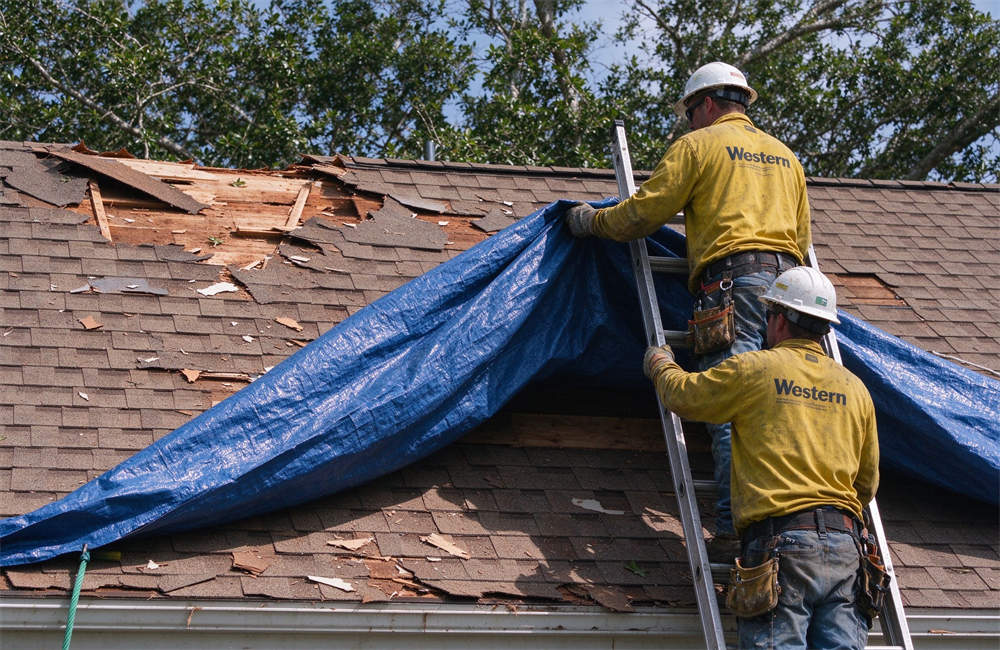
Workers installing emergency roof tarp on damaged house.
The single most requested item after a wind event is a tarp. Not a fancy emergency shelter, not a heavy-duty military tent — a simple 12×16 foot polyethylene tarp that homeowners can nail over a missing roof section to stop the rain from ruining everything inside. Procurement teams that order expensive heavy-duty tarps find themselves with pallets of gear nobody can lift onto a roof. The sweet spot is a 5-mil polyethylene tarp, light enough for two volunteers to carry, tough enough to survive a month of rain.
For a typical county-level response, plan on one tarp per 50 households damaged. If you're pre-positioning for a season, order by the pallet — 100 tarps to a pallet, with enough duct tape and bungee cords to actually get them on the roof. We supply emergency shelter supplies and emergency tarp supplies in full pallet quantities, with custom sizes available for larger jurisdictions.
Beyond tarps, temporary shelter needs include heavy-duty contractor bags for water-damaged belongings, rope and twine for securing tarps, and work gloves that hold up all day. We recommend leather-palmed work gloves — they last much longer than lightweight gloves, so you go through fewer pairs over the course of a response.
A tarp installed wrong catches wind like a sail and tears off. Teach volunteers this sequence:
Step 1: Clear the area. Sweep off loose shingles, nails, and debris. A tarp over sharp nails tears within hours.
Step 2: Overlap from the top down. Start at the highest point of damage and work downward. Water runs downhill — upper layer over lower layer keeps rain out.
Step 3: Secure on all sides. Use 4×2 wood battens screwed through the tarp into roof decking, not just bungee cords. Weight edges with sandbags if you can't screw into the roof.
A properly installed 5-mil UV-treated polyethylene tarp with metal grommets every 2 feet holds for 2–4 weeks through rain and wind. Not a permanent repair, but it stops interior damage until a roofer arrives.
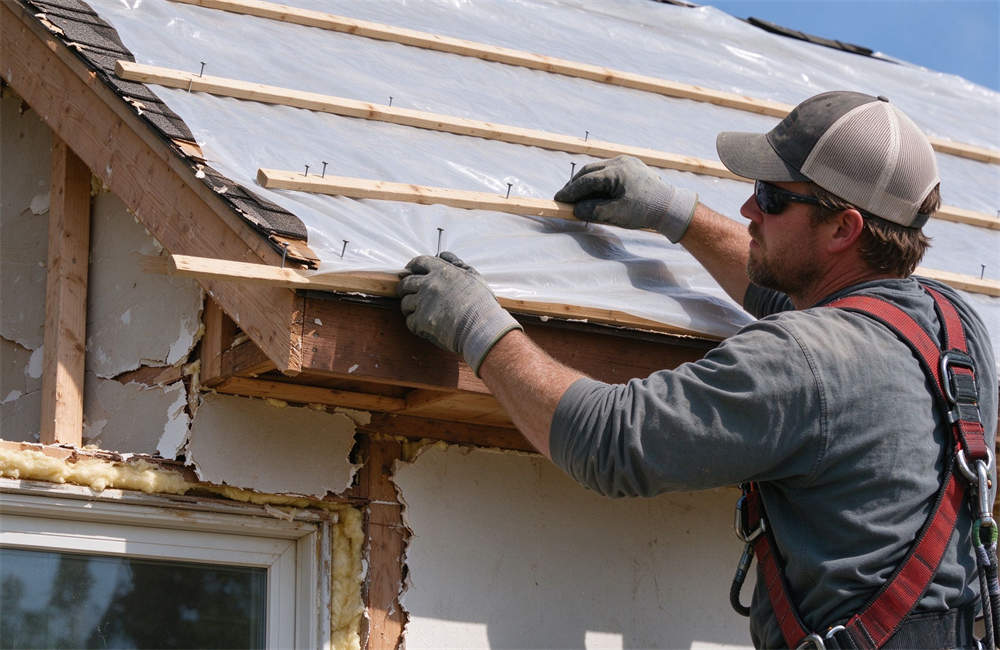
Worker securing tarp with wood battens and nails.
Wind damage scenes are full of sharp edges: broken glass, bent nails, twisted metal siding, splintered wood. Crews doing tarp work and debris clearance need personal protective equipment that meets real safety standards — EN397, ANSI Z87.1, ASTM F2413.
Hard hats (EN397 certified) are non-negotiable — falling branches and roofing nails are the #1 injury on wind sites. Work gloves with leather palms because plywood, shingles, and metal edges cut through lightweight gloves quickly. Safety glasses (ANSI Z87.1) for flying nails and sawdust. High-visibility vests (Class 2) because crews work near roads and utility trucks. Steel-toe boots (ASTM F2413) because falling debris on feet is the most common wind-response injury.
We stock EN397 hard hats in multiple colors — yellow for ground crews, white for supervisors, orange for chainsaw operators — so incident command can see roles at a glance. Our hard hats meet the EN397 impact and penetration standard, tested for real jobsite conditions.
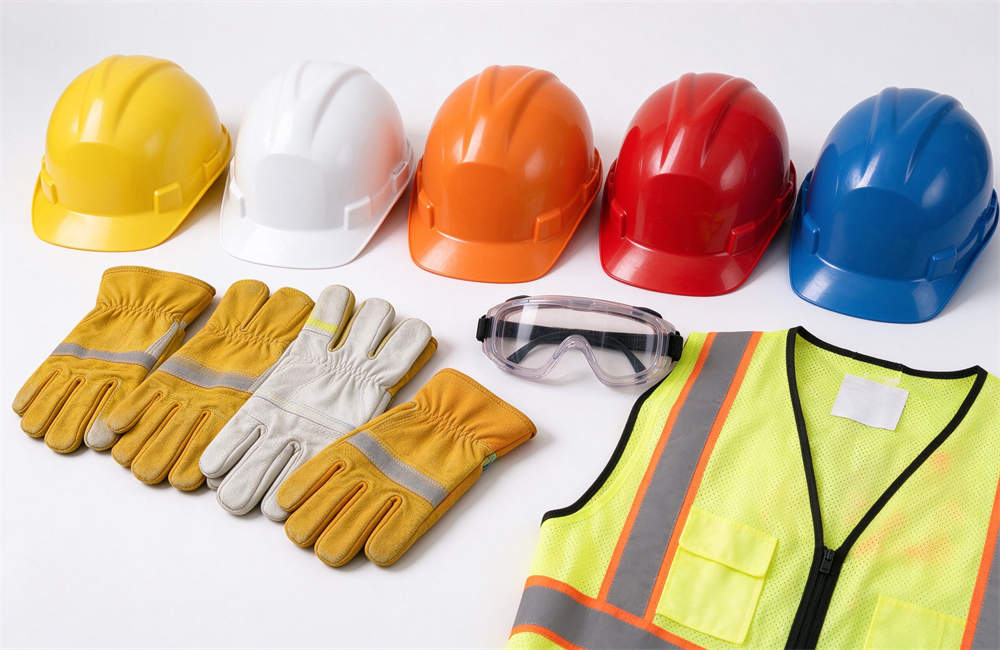
PPE family: multi-color hard hats, gloves, goggles, vests.
When the power goes out for a week, water becomes the bottleneck. Municipal water systems rely on pumps. Pumps need electricity. If the grid is down long enough, taps run dry. Relief organizations that pre-stage foldable water bladder tanks can deploy thousands of gallons of drinking water within hours, without waiting for tanker trucks to arrive from the next county.
The math is straightforward: 1 gallon per person per day, minimum. A 50-person shelter running for 5 days needs 250 gallons. A 500-person shelter for a week needs 3,500 gallons. A 5000L water bladder (about 1,320 gallons) fits in the bed of a pickup truck and deploys in 15 minutes. For larger events, you daisy-chain multiple tanks together.
Sanitation goes hand in hand with water. Hand-washing stations, portable toilets, and bulk hand sanitizer matter because when municipal sewer is backed up, public health becomes the next emergency. We focus on the water storage side — bladder tanks, folding jerry cans, and replacement filters — and work with partners for sanitation.
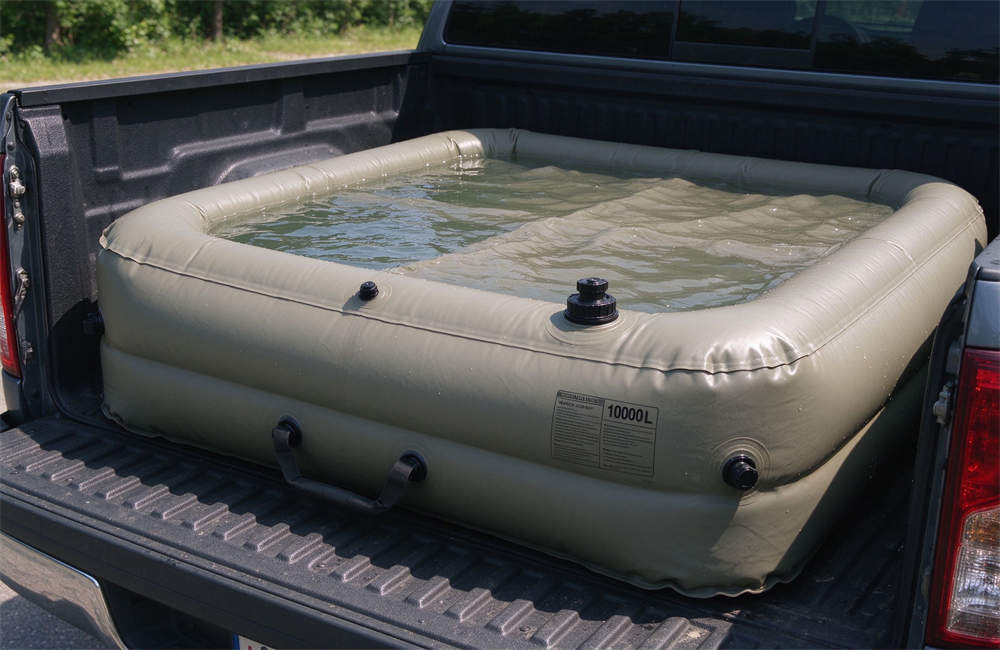
1000L foldable water bladder in pickup truck bed.
We supply foldable water bladders in five sizes to match different shelter populations. The 500L size (about 132 gallons) fits about 100 people for 5 days and deploys in 5 minutes from a pickup truck bed. The 1,000L size fits about 200 people and deploys in 8 minutes. The 2,000L size fits about 400 people. The 5,000L size (about 1,320 gallons) fits about 1,000 people and deploys in 15 minutes from a flatbed trailer. The 10,000L size fits about 2,000 people.
All bladders fold flat when empty — a 5,000L tank folds down to the size of a suitcase, so you can stage several in a warehouse and deploy them together. Made from food-grade PVC, UV-resistant, with a fill port and a drain valve.
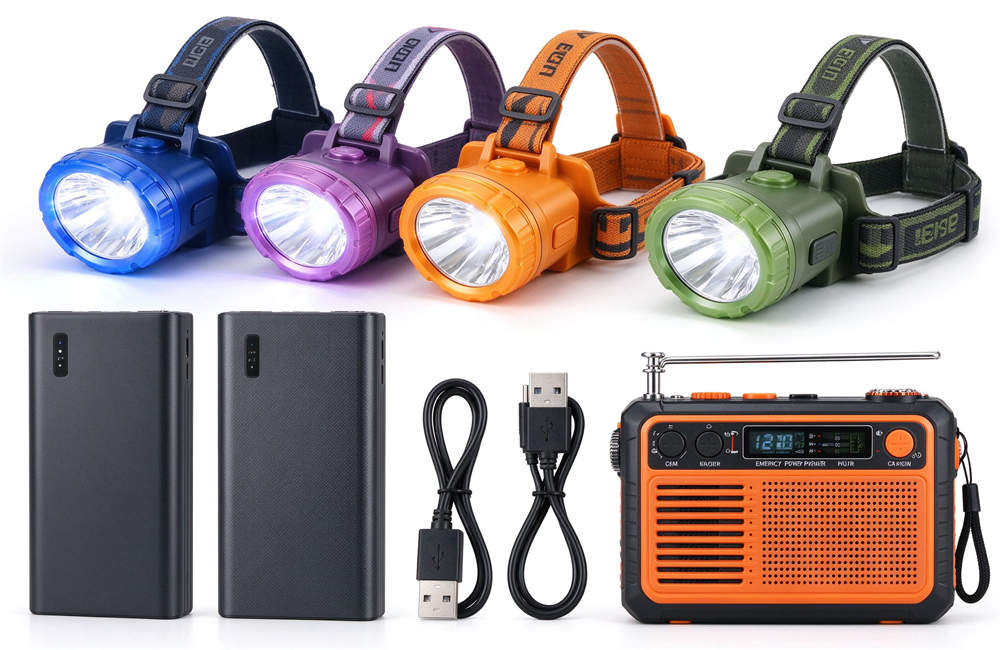
Power gear: LED headlamps, power banks, emergency radio.
Wind events don't just knock out power for a few hours. The derecho that swept across the Midwest in 2020 left more than a million people without power for up to a week. When shelters open, they need portable generator units to run lighting, charge phones, and power medical equipment.
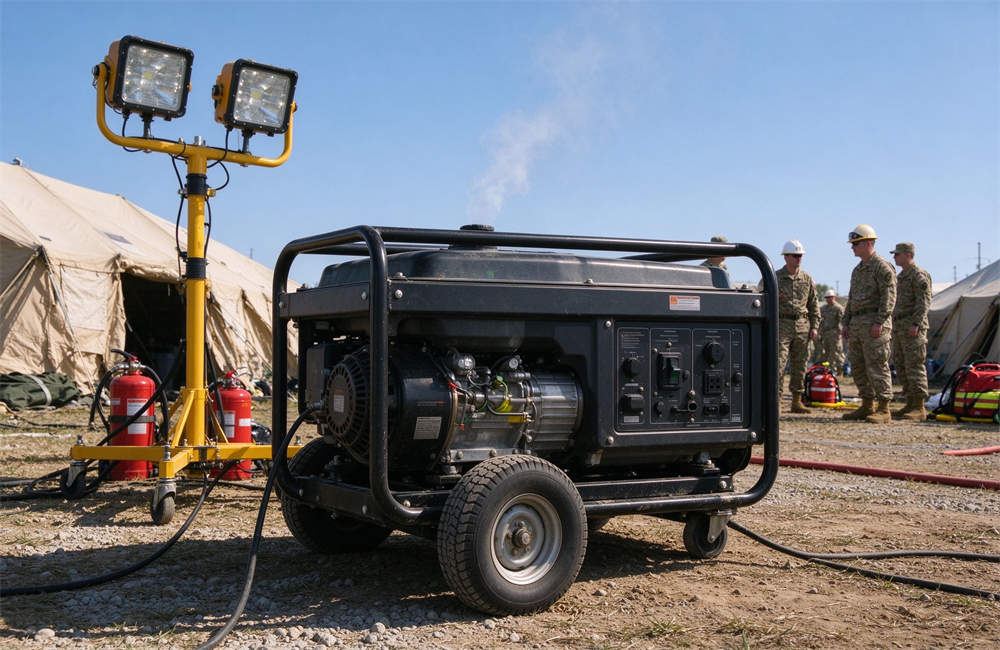
Generator and mobile light tower at relief camp.
For relief organizations, the key is to choose generators that can handle extended outages. We recommend open-frame industrial generators — 3kW to 5kW — that run for 12+ hours on a tank and can be refueled safely in the field. Pair them with portable light towers for night work sites, and you have a self-contained power package that doesn't depend on the grid coming back.
For individual families, hand-crank emergency radios and LED headlamps matter. A hand crank emergency radio doesn't need batteries, doesn't need charging, and picks up NOAA weather alerts even when cell towers are down. We stock these in bulk for distribution kits.
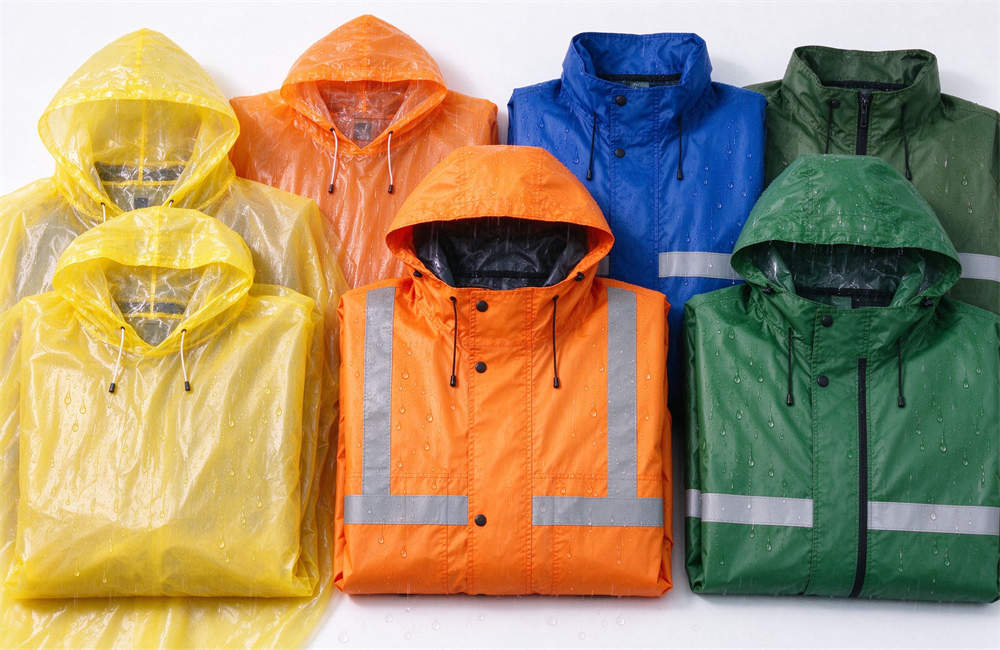
Rain gear family: multi-color ponchos and reflective jackets.
Lighting demand shifts over the first 72 hours of a wind outage. In the first 0-4 hours (immediate response, dark), every responder needs a headlamp and flashlight. By 4-12 hours (shelter opens, night falls), you need four work lights on stands per shelter. At 12-48 hours (extended outage, work continues), you need a portable light tower per staging area. By 48-72 hours (debris cleanup in dark), every crew needs two helmet lamps plus work lights. For family distribution, each household gets an LED headlamp plus a hand-crank radio.
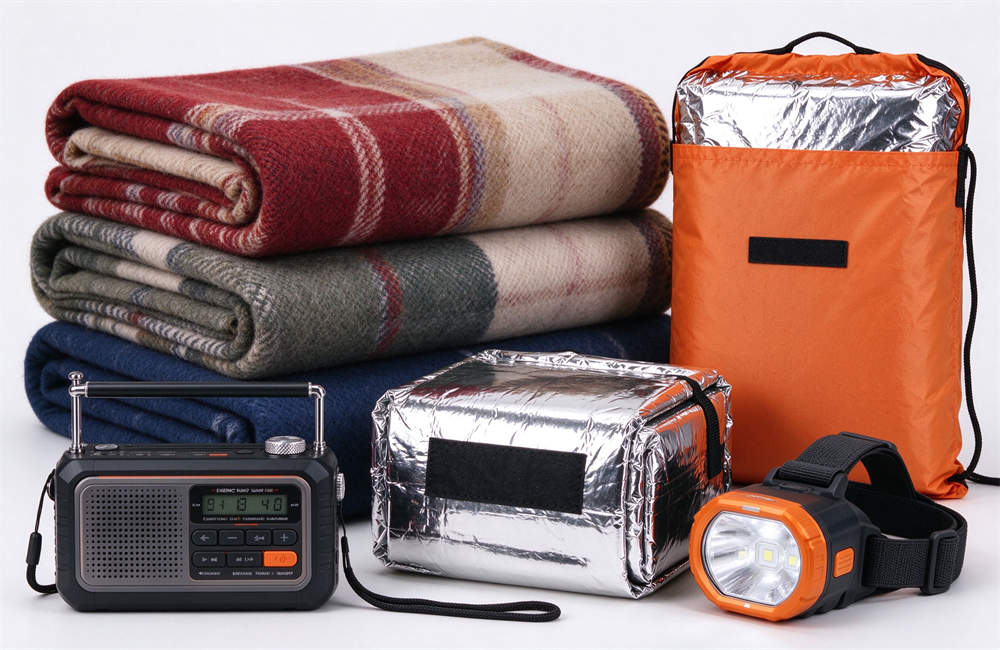
Warmth gear: wool blankets, sleeping bags, radio, headlamp.
Wind events happen in every season. A summer derecho leaves families without air conditioning in 90°F heat. A winter windstorm leaves families without heat in 20°F cold. Your stockpile needs to cover both ends of the thermometer.
In cold weather, wool blankets and emergency sleeping bags are the baseline. A 3.5lb wool blanket is warm even when wet, which matters when families are pulled from a water-damaged home. In hot weather, cooling towels and sun shade canopies matter. An emergency cooling towel around the neck drops body temperature by several degrees for hours, which is the difference between a safe rest break and a heat exhaustion incident.
Rain ponchos and windbreakers go in every distribution kit. Wind plus rain plus an unheated shelter is a hypothermia setup even in spring and fall. A $2 disposable poncho is the cheapest hypothermia prevention you can buy.
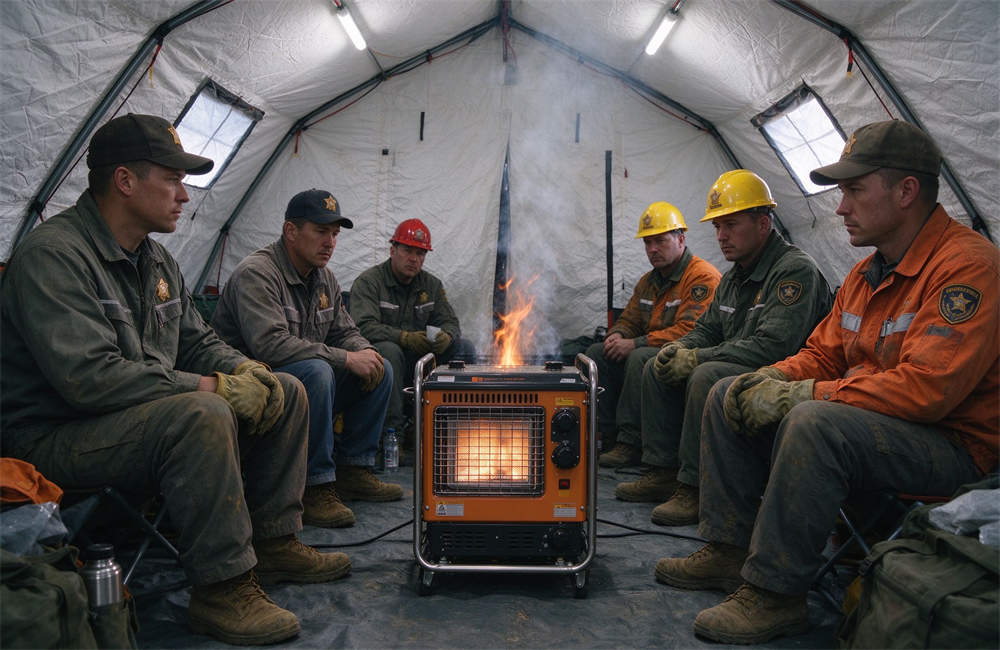
Workers staying warm around portable tent heater.
Before the tarps go on, debris has to come off. Wind events leave branches on roofs, shingles in the yard, and fence parts across driveways. Crews need hand tools built for all-day use on a debris site.
The essential kit: a 36-inch pry bar for pulling nails and lifting plywood, a standard axe for small branches, a folding handsaw for tight spots, and a pair of leather work gloves. For larger operations, chainsaws and pole saws matter, but those need trained operators — don't hand a chainsaw to an untrained volunteer and expect a good outcome.
We supply wildland firefighting tools and general debris-clearance tools in bulk, with American hickory handles built for heavy prying and nail-pulling work.
Trees across driveways and on roofs are the most dangerous debris to clear. Follow this sequence every time:
1. Assess stability first. Is the tree still moving? Is it on power lines? If there's any chance it shifts, don't go under it. Wait for the utility company to de-energize lines and for the tree to be secured.
2. Cut from the branches down. Start with the smallest branches on top, work your way to the trunk. Don't try to cut the trunk first — the weight of the upper branches will bind the saw bar.
3. Use the right tool for the job. A chainsaw for trunks, a bow saw for medium branches, loppers for small stuff. A 36-inch pry bar lifts cut sections out of the way. A fire axe chops through small trunks and splits firewood from downed trees.
4. Never work alone. Spotter, cutter, and a third person who moves the cut sections. Tired chainsaw operators make mistakes. Rotate every 30 minutes.
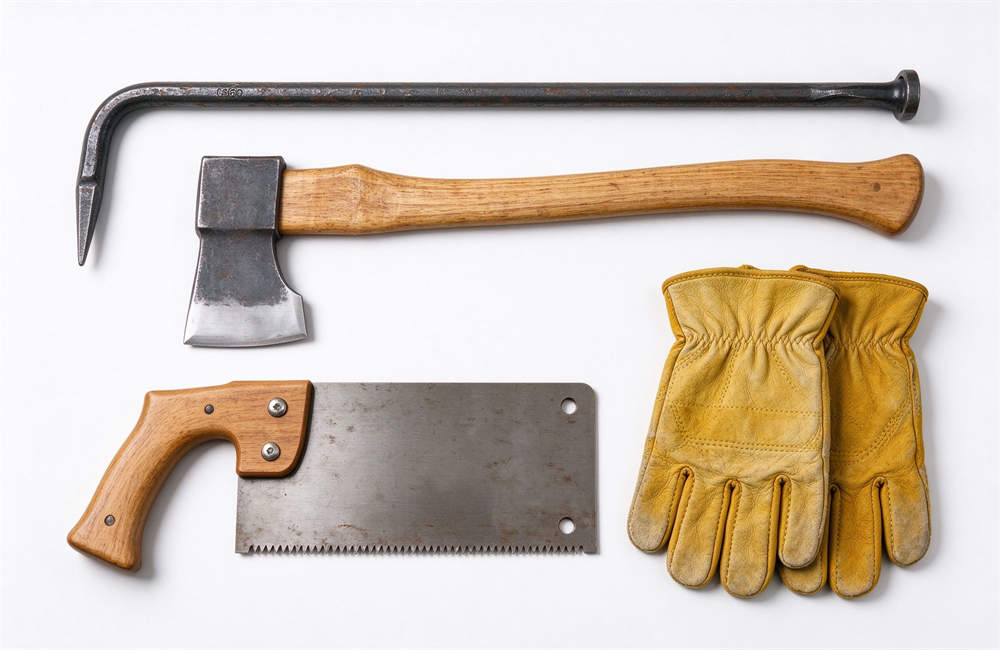
Debris tools: pry bar, axe, folding saw, leather gloves.
When families can't stay in their homes, they end up at a school gym, a church basement, or a community center. These shelters turn into overnight stays that stretch into weeks. The supplies that make or break a shelter are not the fancy ones — they're the basics.
Folding cots are non-negotiable. Families can't sleep on a gym floor for a week. The right cot is a 600lb-capacity steel frame that folds flat, stacks 20 high, and wipes down between uses. We supply shelter cots wholesale in carton quantities — pair cots with wool blankets and pillow kits, and you have a shelter that doesn't feel like a gymnasium.
Other shelter basics: hygiene kits (toothbrush, toothpaste, soap, a towel), water cups, and battery-powered lanterns for when the gym lights go out. The evacuation shelter supplies list is longer than this, but these five items cover 90% of what families actually ask for.
When you're setting up a shelter on short notice, here's the baseline gear per 10 residents: one folding cot each (600lb capacity, steel frame, stacks 20 high), 15 wool blankets (extra for warmth and as ground cover), one pillow kit each with a disposable pillowcase, and three battery lanterns per section of the shelter.
Water storage: 20 gallons per day for 10 people — that's 2 gallons per person per day minimum. Trash bags: one roll per 10 people per day. Hygiene kits: one per person, with toothbrush, paste, soap, and towel. We supply all of these in bulk for shelter setup.
For a 100-person shelter, multiply by 10. For a 500-person shelter, you're looking at 500 cots, 750 blankets, and a 5000L water bladder running continuously. These numbers sound large until you've actually set one up — then you'll wish you'd brought more.
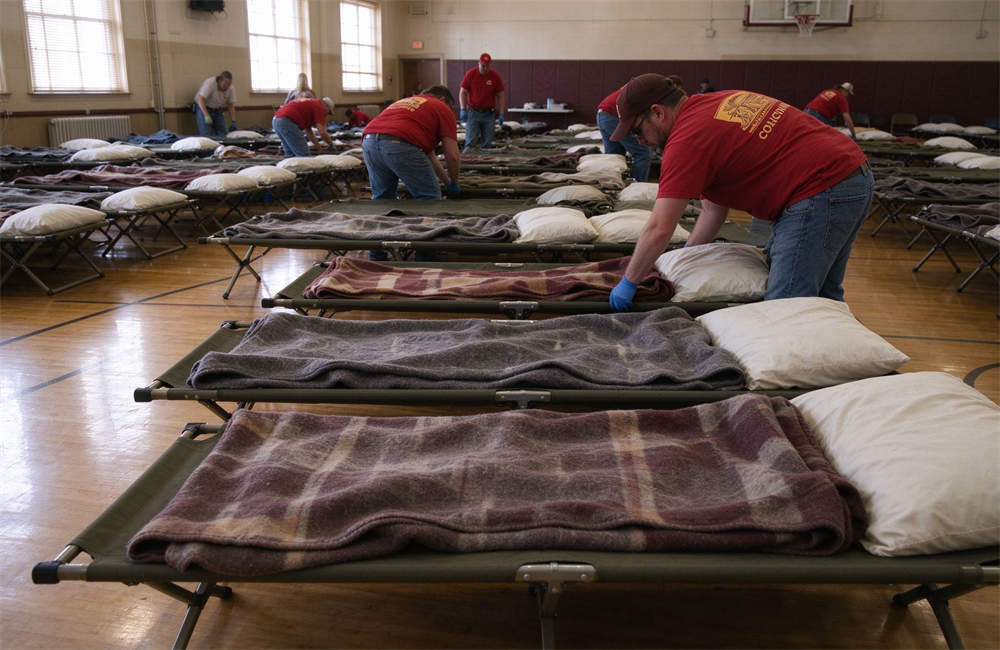
Rows of folding cots in community shelter, with blankets.
The supplies you need on day one are not the supplies you need on day seven. Plan for the shift:
Immediate (0–48 hours): search & rescue, roof cover, debris clearance. You need tarps, chainsaws, PPE, gloves, and hand tools — the immediate response gear.
Short-term (3–7 days): shelter opens, people displaced, power still out. Now you need cots, blankets, water bladders, generators, and lighting — the longer-duration shelter gear.
Medium-term (1–4 weeks): repairs begin, families return home. Now you need more tarps, hygiene kits, and cleaning supplies — the recovery-phase gear.
The organizations that fail are the ones that stock only for day one — tarps and gloves — and run out of cots and blankets by day three. Plan the whole week, not just the first 48 hours.
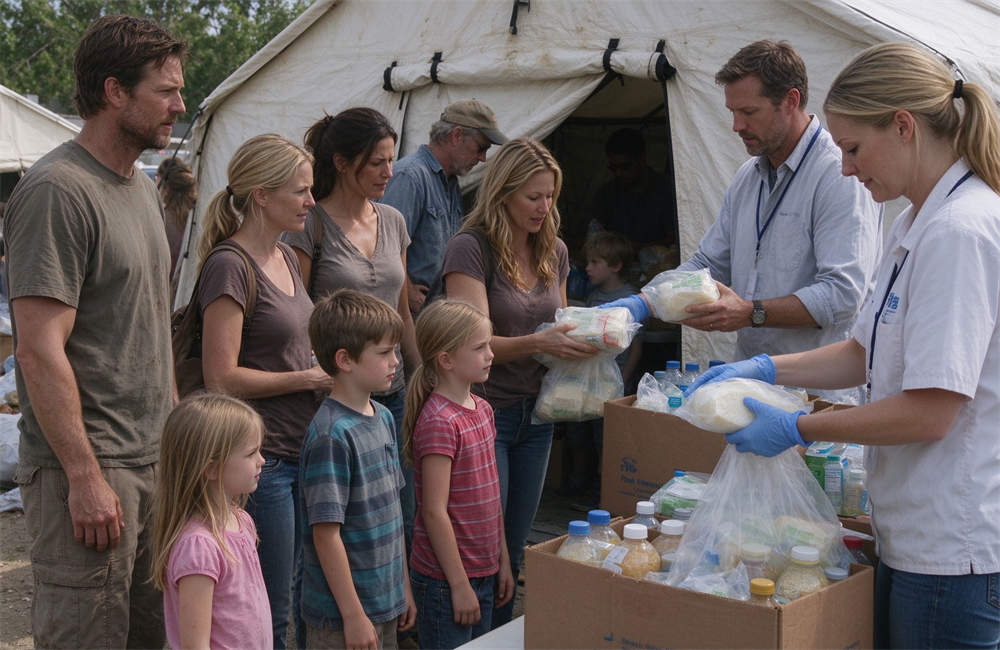
Families lining up at relief supply distribution tent.
Procurement teams always ask: how much should we buy? The answer depends on your jurisdiction size and what you're trying to cover. Below is a rough starting point for a mid-sized county (population 100,000–250,000):
|
Category |
Quantity (Small Response) |
Quantity (Full Season) |
|
Roof tarps (12×16 ft) |
100 |
500 |
|
Wool blankets |
200 |
1,000 |
|
Folding cots |
50 |
200 |
|
Work gloves (pair) |
200 |
1,000 |
|
Hard hats (multi-color) |
50 |
200 |
|
Foldable water bladders (5000L) |
2 |
10 |
|
Hand-crank radios |
50 |
200 |
|
LED headlamps |
50 |
200 |
These numbers are starting points. Adjust based on your local climate — hurricane regions need more tarps and water, winter regions need more blankets and warmth gear. The Ready.gov guide has jurisdiction-level planning worksheets that can help you refine the numbers. For bulk storm preparedness supplies orders, we can help you calculate exact quantities based on your population and storm history.
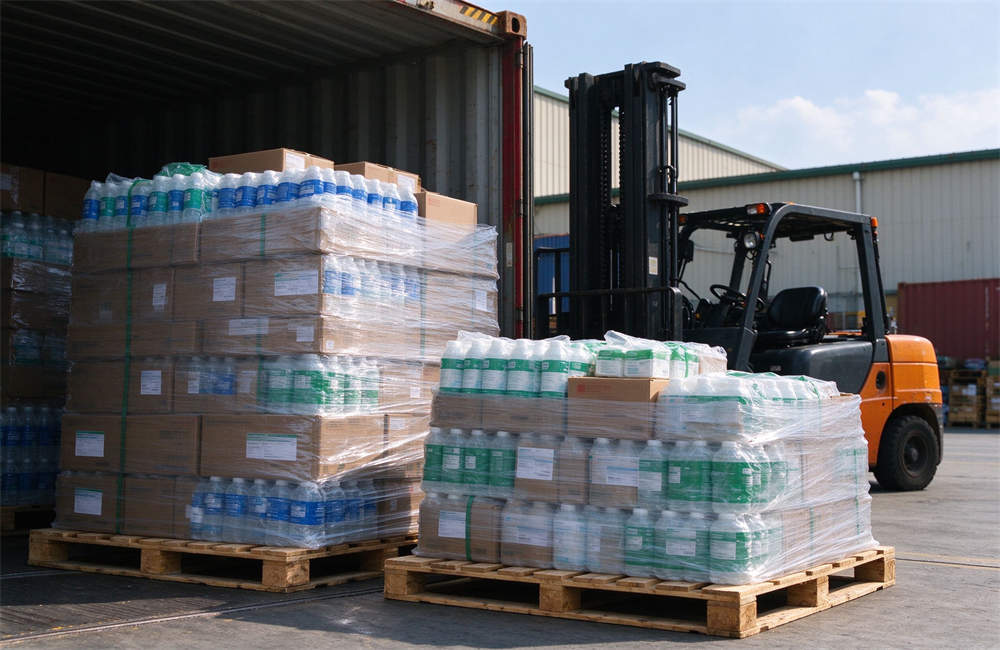
Forklift loading supply pallets into shipping container.
As a China-based manufacturer, we supply wind relief gear to organizations worldwide. Here's what you can expect when you work with us:
1. Stock on hand, ready to ship. We keep core items — tarps, gloves, hard hats, blankets — in our own warehouse, ready to ship within 48 hours. No drop-shipping, no waiting for a factory run. When storm season hits, you need supplies that day, not next month.
2. Pallet quantities for field delivery. When you need 500 tarps, they come on one pallet, wrapped and labeled. One truck, one dock, one receipt — the way relief teams actually receive goods in the field. We also do smaller carton quantities for pilot programs.
3. Full certification documentation. Every product ships with its test report: EN397 for hard hats, EN403 for smoke protection, CE for PPE. We provide the full certification document with every order, so your procurement team has everything they need for audits and compliance.
4. Trial orders welcome. Most teams start with a small trial order — 100 tarps, a case of hard hats — to check quality before committing to a pallet. We're happy to support that. We've built long-term relationships with teams that started with a single trial order.
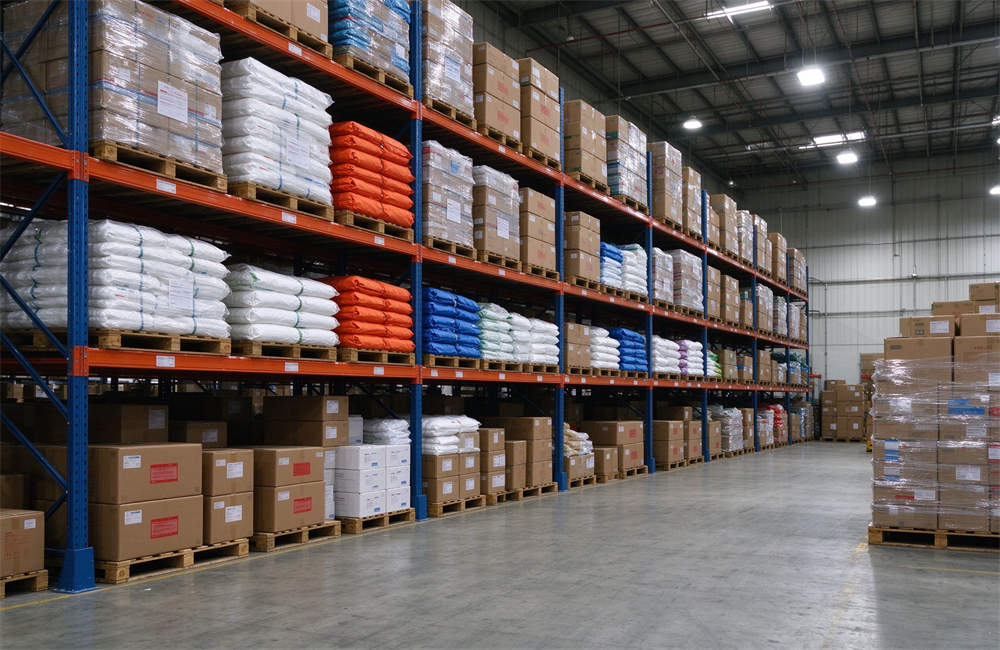
Organized warehouse: emergency relief supplies on shelves.
After years of shipping wind supplies to relief teams worldwide, here are the tips we share with every new customer:
Tip 1: Stock the basics first. It's easy to order cool-looking emergency kits with multi-tools and whistles. But after a wind event, 9 out of 10 requests are for a tarp, a bottle of water, and a blanket. We recommend buying the basics in bulk first, then adding specialty items.
Tip 2: Order 30% more consumables. Gloves wear out fast. Batteries die. We see teams order exactly the number they think they need, then run out two days into the response. Order 30% more than you think you need — you will go through them.
Tip 3: Balance price and quality. The cheapest tarp on the market might rip in the first rainstorm. We offer mid-tier products that balance cost and durability — so you don't have to reorder halfway through the response.
Tip 4: Test the gear before you need it. We recommend unrolling a tarp, putting on a hard hat, and turning on a radio before you deploy. If it doesn't work in your warehouse, it won't work in the field.
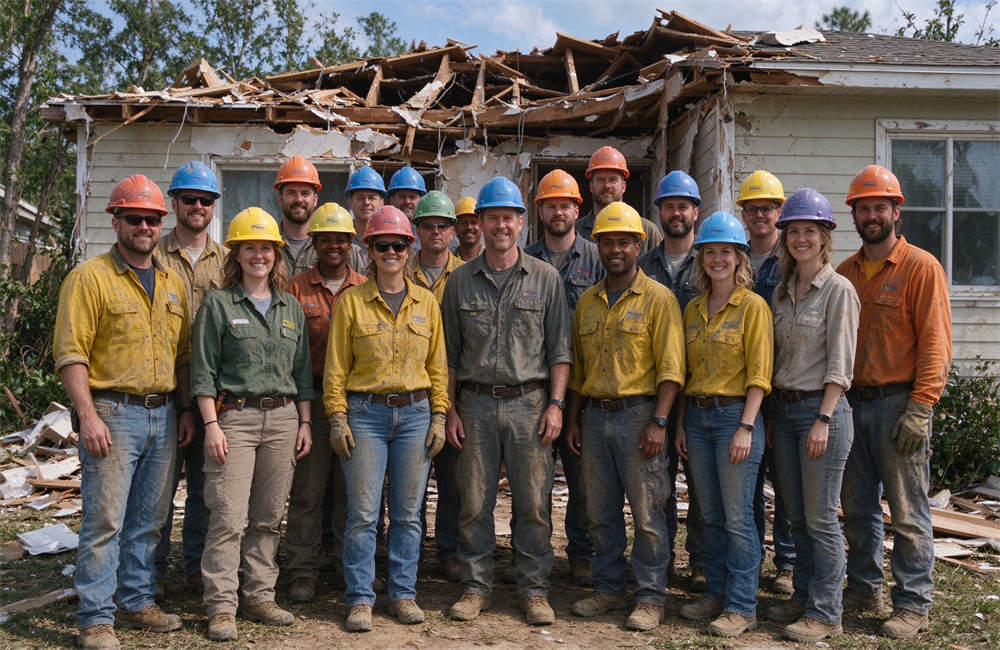
Relief volunteers team in front of damaged house.
Plan on one 12×16 ft tarp per 50 households with roof damage. If 200 houses are damaged, that's 4 tarps. Order 20% extra because some will be torn during installation.
For most relief teams, the 5000L (1,320 gallon) foldable bladder is the sweet spot — it fits in a pickup bed, deploys in 15 minutes, and holds enough water for a 100-person shelter for a week. Larger 10,000L tanks work for permanent shelters but are too heavy for rapid deployment.
Only if you have trained chainsaw operators. Untrained volunteers with chainsaws are a liability. Most jurisdictions rely on public works departments and volunteer chainsaw teams, so you're better off stocking PPE and support gear than buying saws you can't safely operate.
Tarps and blankets last 5–10 years in dry storage. Batteries last 3–5 years. Check expiration dates on anything with a battery or chemical component, and rotate stock on a 3-year cycle.
Yes. We supply individual components in bulk — tarps, blankets, gloves, cots, water bladders — so you can build the exact kit that fits your jurisdiction. We don't force you to buy pre-made kits that include stuff you don't need. This emergency supplies manufacturer approach means you only pay for what you actually use.
Ready to stock up on high wind emergency supplies?
We work with relief organizations worldwide to supply durable, certified disaster relief gear at wholesale pricing.
 |

|
Дружественные ссылки :
авторское право © Custom Disaster - Relief Bedding: Tents, Sleeping Bags, Blankets Все права защищены
профессиональная команда для обслуживания !