Категории
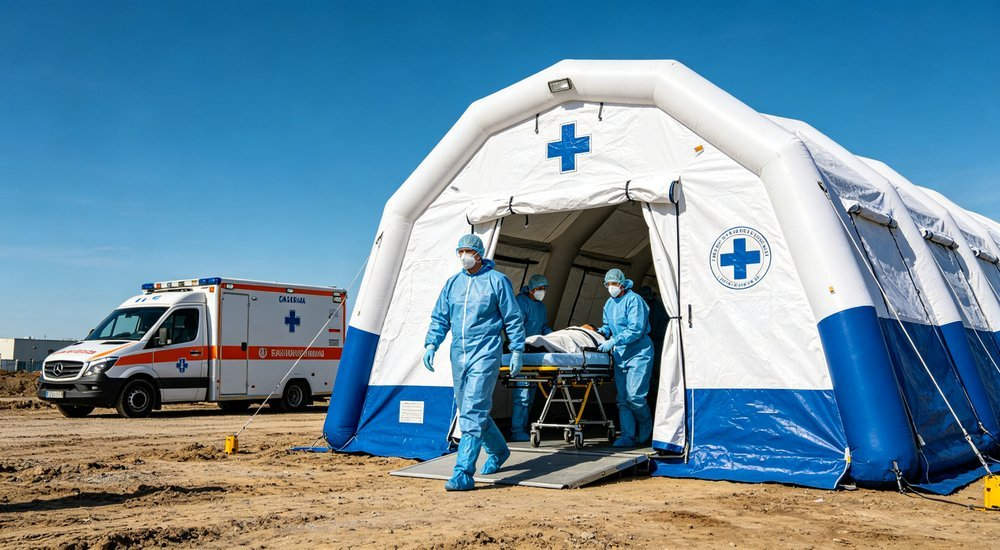
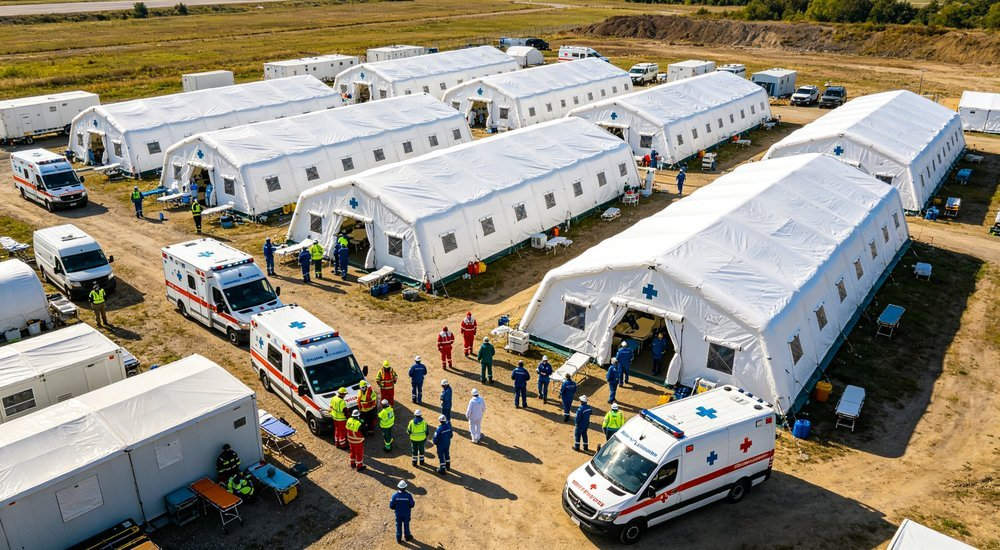
Inflatable medical tent systems, also known as medical emergency inflatable tents, are purpose-built rapid-deployment shelters that establish emergency medical shelter facilities in disaster zones, remote areas and emergency response sites worldwide. This makes our custom tent ideal for international procurement.
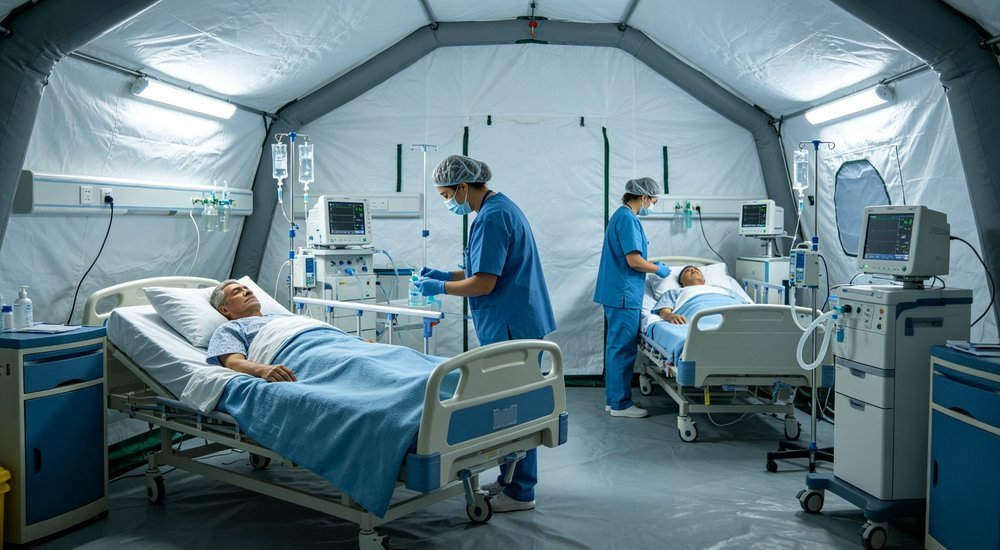
The interior of a medical inflatable tent can be configured as a fully equipped field hospital with patient beds, IV stands, diagnostic equipment and medical support tent infrastructure and dedicated procedure areas. Bright LED lighting, insulated flooring and climate control options ensure that medical staff can work comfortably in extreme temperatures, while the air-beam structure provides a stable, pole-free interior that maximizes usable floor space. This allows medical teams to deliver the same standard of care they would provide in a permanent clinic, even in the most challenging field conditions. This makes our bulk tent ideal for international procurement.
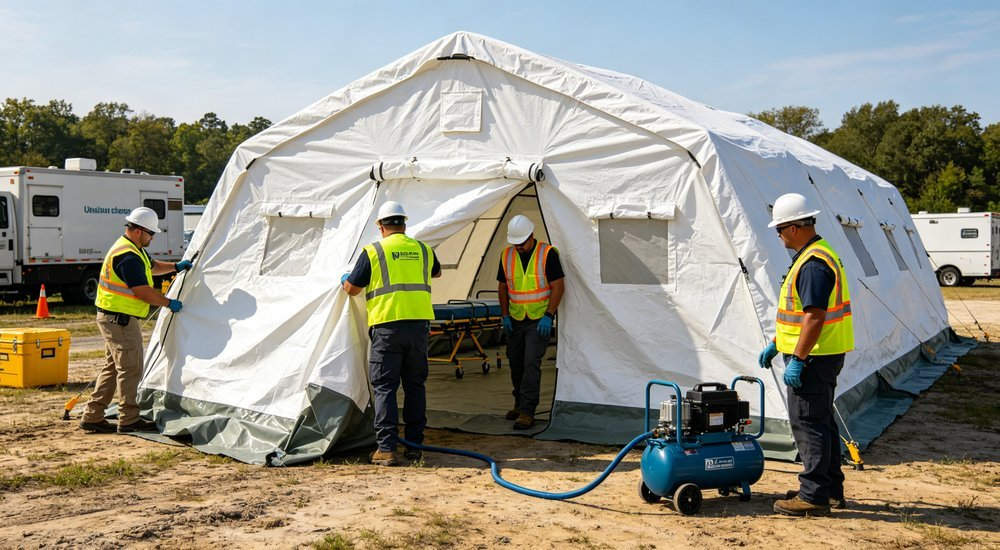
The rapid deployment medical tent design is the defining advantage of air-beam medical tents. Traditional frame tents require 30-60 minutes, whereas an inflatable clinic tent achieves full structural rigidity in minutes of setup with multiple trained personnel, whereas inflatable models use high-pressure electric pumps to reach full structural rigidity in minutes. The entire system packs into a compact carry bag weighing 120-180kg, transportable by pickup truck, helicopter or even cargo bicycle in areas with limited road access. This speed difference can mean the gap between life and death during the critical first hours of a mass casualty event or disease outbreak. This makes our tent export ideal for international procurement.
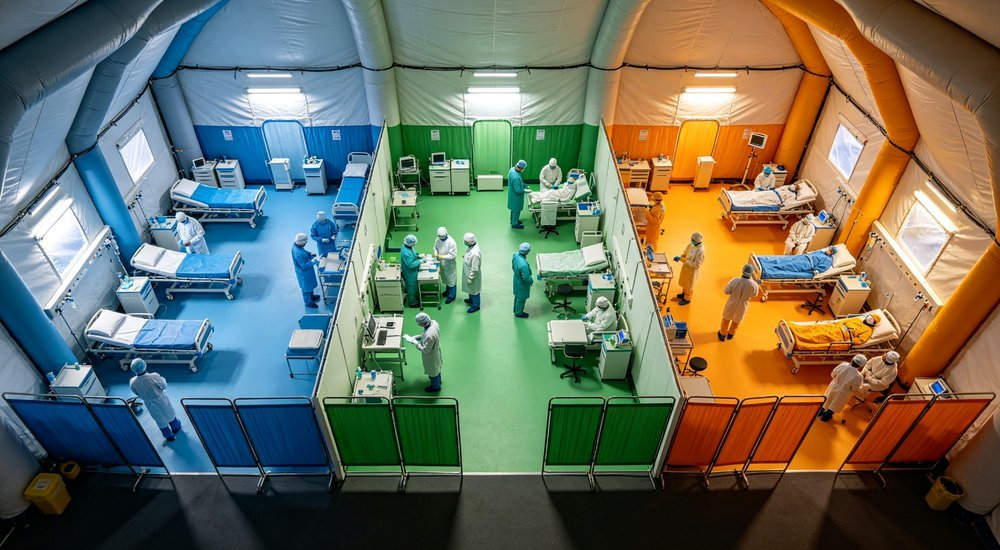
Infection control is built into every layer of a professional medical inflatable tent. The medical tent three zone design separates clean areas, making this inflatable medical shelter ideal for medical triage tent operations and disaster medical tent deployments (staff preparation and supply storage), buffer zones (donning and doffing PPE) and contaminated zones (patient treatment and isolation), with dedicated entrances and exits for each area to prevent cross-contamination. Optional negative-pressure systems exhaust filtered air from isolation sections, making these tents suitable for managing infectious disease outbreaks, chemical exposure incidents and biohazard response scenarios. This makes our China tent ideal for international procurement.
Beyond disaster response, mobile medical inflatable clinics serve ongoing humanitarian missions in underserved communities around the world. Organizations like the Red Cross, Doctors Without Borders and UN health agencies deploy these tents as permanent outpatient facilities in refugee camps, rural villages and conflict zones where local healthcare infrastructure has been destroyed or never existed. Their durability, low maintenance requirements and ability to be relocated as needs change make them one of the most cost-effective investments in global health emergency preparedness.
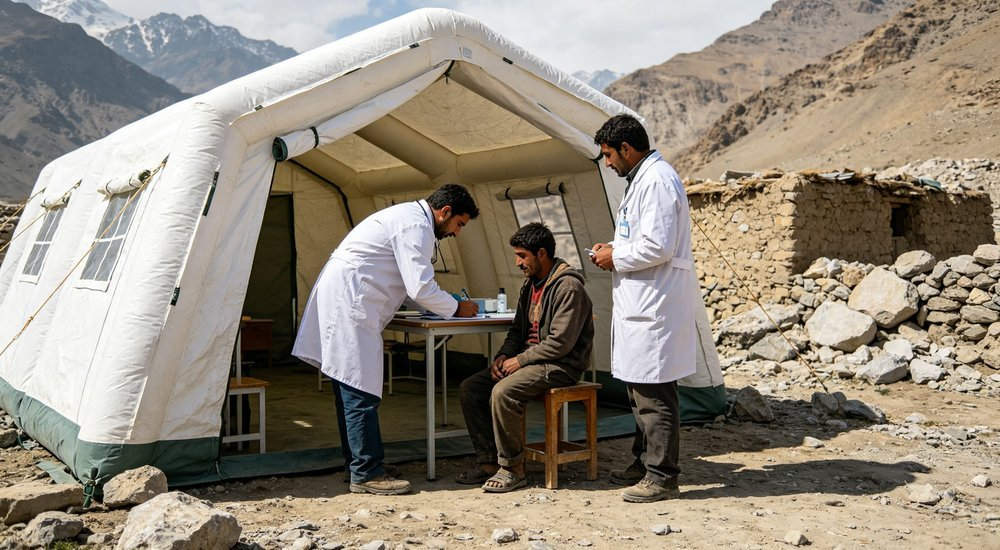
For procurement teams evaluating medical emergency inflatable tents, the key decisions involve size and capacity, infection control specifications, power and medical gas infrastructure, climate adaptation and total cost of ownership. The following guide walks through every critical specification, compares medical-grade tents against consumer alternatives, provides a complete inquiry checklist and outlines what professional buyers should expect from a qualified medical tent manufacturer and supplier.
This comparison table outlines key specifications for medical inflatable tent. Procurement teams use this data to evaluate field hospital shelter options, compare pricing structures, and verify compliance with international standards. As an experienced emergency medical tent, we ensure every parameter meets field deployment requirements for emergency response operations worldwide. This information is particularly valuable for government procurement teams, NGO aid organizations, and international relief agencies evaluating bulk supply contracts.
This comparison table provides essential specifications for procurement evaluation. Buyers use this data to compare configurations, assess material quality, and calculate total project costs. As a professional tent manufacturer with extensive export experience, we ensure all parameters meet international standards and field deployment requirements. This information is particularly valuable for government procurement teams, NGO aid organizations, and international relief agencies evaluating bulk supply contracts.
| 1. What is a medical emergency inflatable tent? | 9. What a complete medical set includes |
| 2. Why air-beam suits rapid medical deployment | 10. Medical tent inquiry checklist |
| 3. Where medical inflatable tents fit (use cases) | 11. What a good supplier reply looks like |
| 4. Not the same as a camping or general shelter | 12. Medical emergency tent price range |
| 5. How to choose the right medical tent size | 13. MOQ and lead time for wholesale medical tent orders |
| 6. Medical inflatable tent vs regular tent | 14. Packing & shipping information |
| 7. Three-zone design: clean, buffer, and contaminated | 15. Certifications & quality control |
| 8. Medical equipment interfaces and power demand | 16. Frequently Asked Questions |
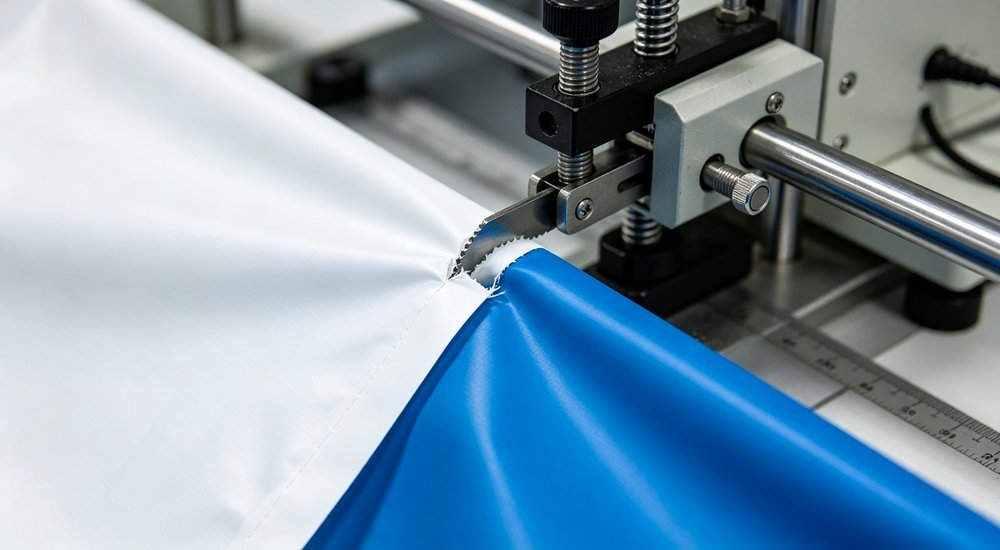
A medical emergency inflatable tent is an air-beam shelter engineered to serve as a clinical workspace. Unlike a general-purpose emergency shelter, it starts with a medical-grade fabric — typically anti-bacterial PVC at 280-420g/m² with PU5000mm waterproofing and flame retardant treatment — and adds sealed seams, wipe-clean surfaces, and interior fittings designed around patient care.

Proper maintenance ensures long-term reliability in field conditions. As a leading disaster relief tent,
All units undergo rigorous quality inspection before dispatch.
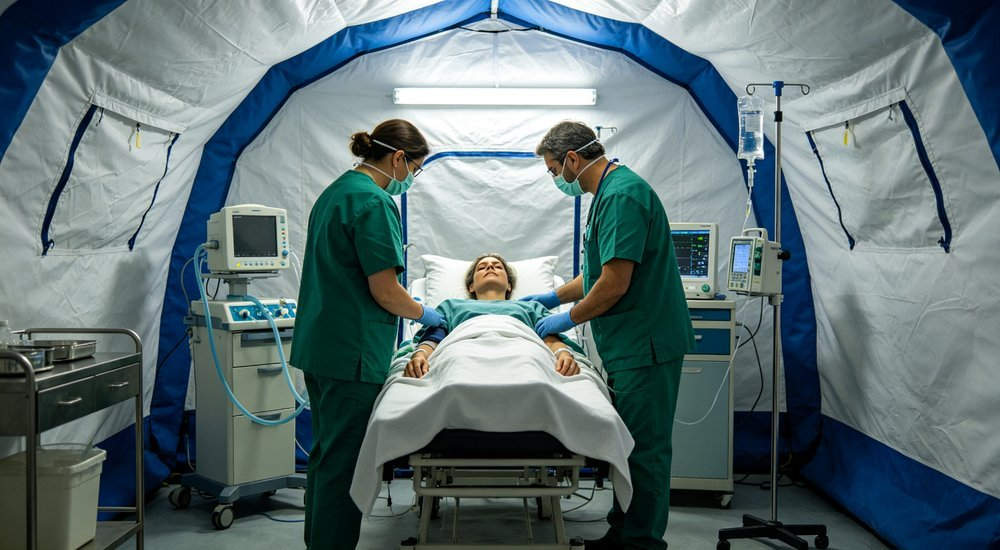
Proper maintenance ensures long-term reliability in field conditions.
All units undergo rigorous quality inspection before dispatch.

Field deployments require rapid setup and reliable structural performance.
Each model is tested and certified before shipment.
Each configuration is designed for specific medical response scenarios.
Proper configuration ensures optimal patient flow and infection control.
Proper medical tent configuration ensures optimal patient flow and infection control protocols.
Proper medical tent configuration ensures optimal patient flow and infection control protocols.
Proper medical tent configuration ensures optimal patient flow and infection control protocols.
Proper medical tent configuration ensures optimal patient flow and infection control protocols.
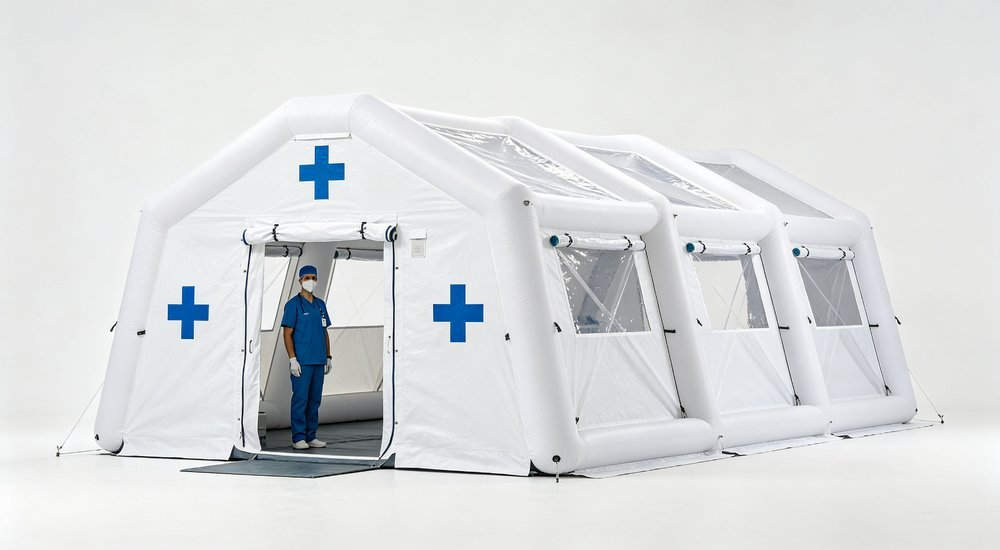
The air beams inflate to 0.3-0.8 bar and hold the shelter shape. But the real work happens after inflation: connecting the HEPA filtration unit, balancing the pressure differential between zones, mounting medical equipment, and testing the airflow direction. A field hospital tent or negative pressure medical shelter is a system, not just a structure.
Common applications include:
Each use case demands a different internal layout, airflow rate, and equipment specification. A tent named "medical" in a product catalog does not tell you whether it can hold a surgical lamp, maintain -20 Pa negative pressure, or filter air to H14 standard.
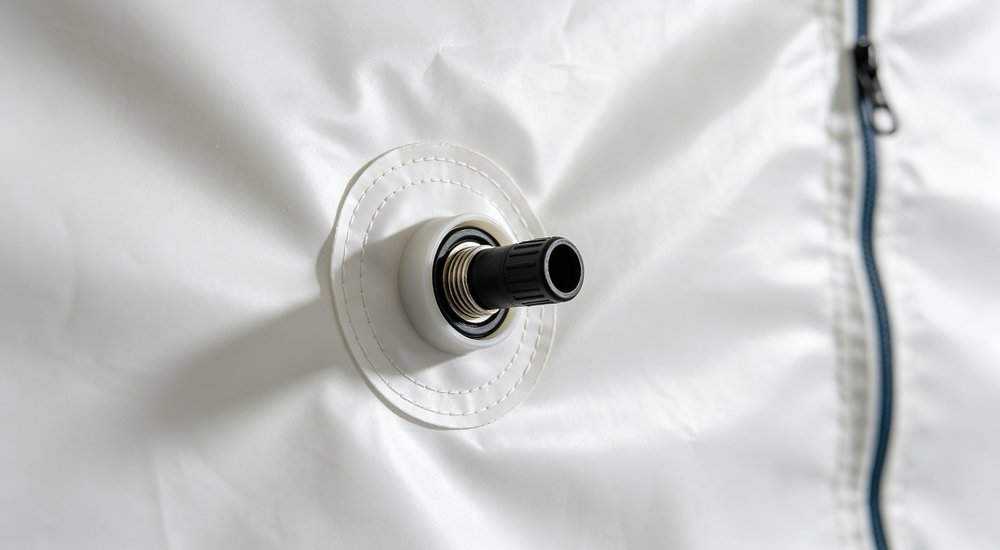
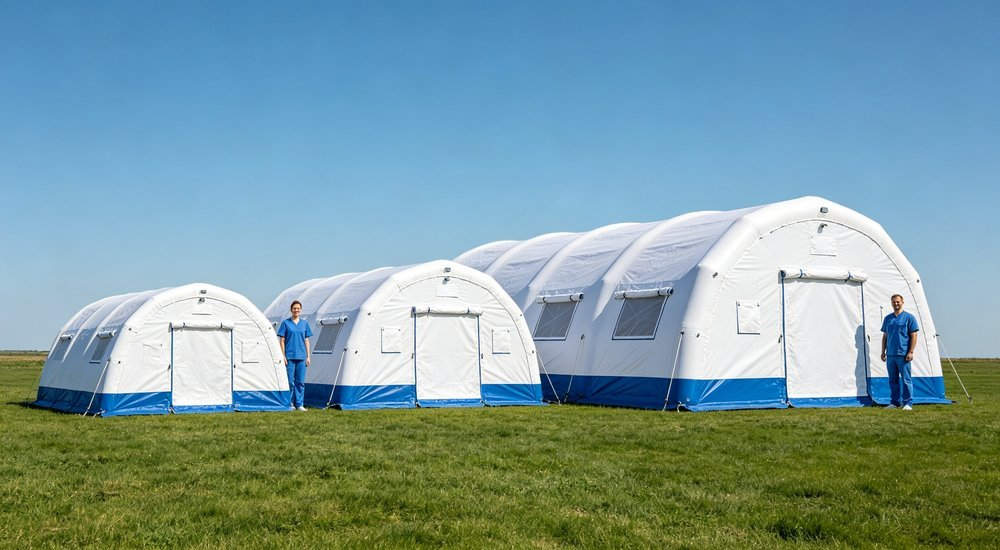
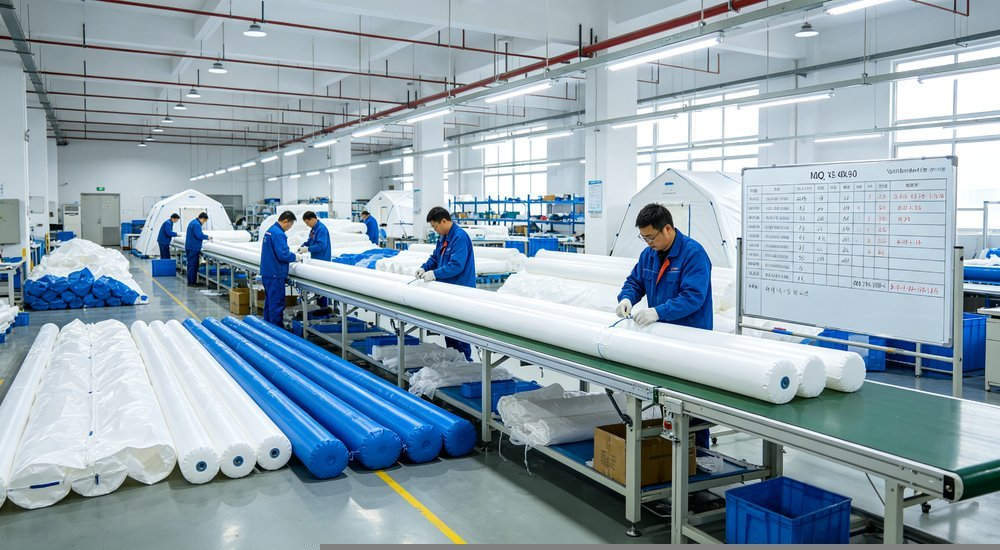
Medical emergencies demand speed. A portable field hospital must be operational within hours, not days. Air-beam construction replaces rigid pole frames with inflatable columns, which means fewer heavy components, faster setup, and a smaller transport footprint. A 30m² unit packs into 1.5-2.5m³ and weighs 120-180kg — transportable in a standard truck container.
Multi-chamber air-beam design means a single puncture will not collapse the whole shelter. Each column is an independent pressure chamber. Working pressure is 0.3-0.8 bar, and a 24-hour air retention test is standard before every unit leaves the factory.
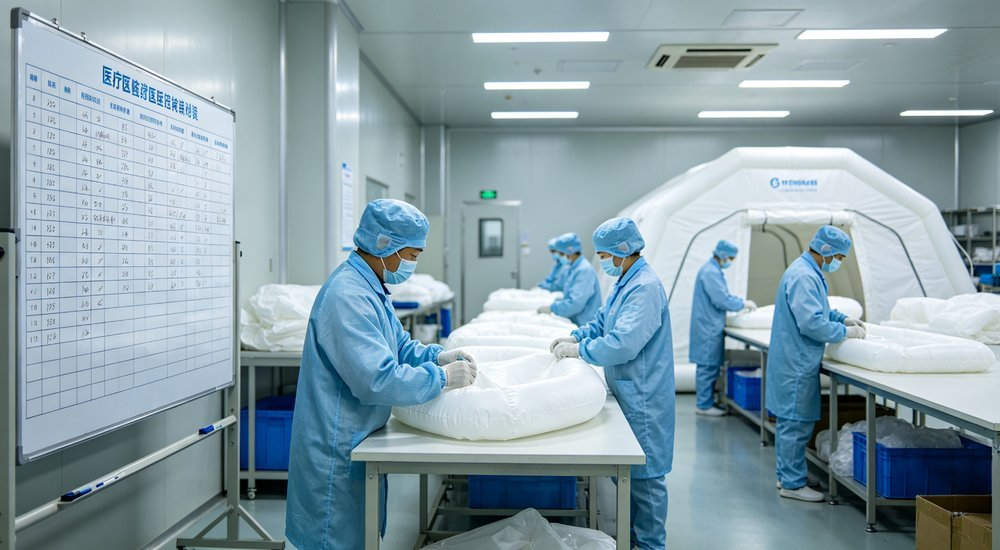
For medical use, the air-beam structure also matters for infection control. The smooth, curved interior surfaces are easier to wipe down and disinfect than a pole-frame tent with its many corners and joints. The fabric itself is treated with an anti-bacterial coating that resists microbial growth — an essential detail for any medical grade tent.
Related reading: if you are comparing shelter types for emergency response, see our guide on frame tents vs inflatable structures for a different deployment philosophy. For fire rescue medical support, the fire rescue tent page covers heat-resistant configurations.
A mobile clinic tent or emergency medical tent fits anywhere you need clinical space fast — disaster zones, remote villages, outbreak response, mass vaccination campaigns, or military field hospitals. The key is matching the tent configuration to the actual medical task.
Triage tent: a 15-20m² open space with benches, lighting, and basic power. Patients enter, are assessed, and are directed to treatment or observation. No negative pressure required unless infection control is a concern.
Isolation / quarantine inflatable shelter: a single-zone or two-zone unit with negative pressure exhaust through HEPA H13/H14, pressure monitoring at -15 to -30 Pa, and airlock entry. Designed for respiratory infections.
Field hospital / mobile medical unit tent: a multi-zone modular system covering 40-60m², with clean zone (staff, supplies), buffer zone (gowning, handwashing), and contaminated zone (patient beds). Includes surgical lighting, oxygen outlets, and UPS-backed power. See decontamination tents for the related wash-down workflow that often sits adjacent to a field hospital.
Field surgery tent: the highest specification. Requires a clean-zone operating area with directional airflow, HEPA H14 filtration, surgical pendants for gas and power, and a laminar flow ceiling. Typically 20-30m² dedicated solely to the operating theater.
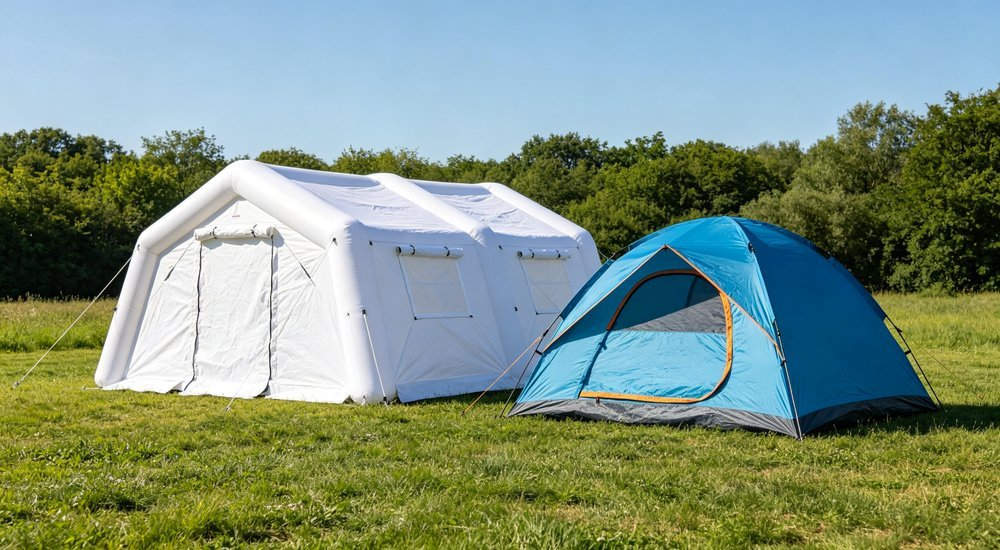
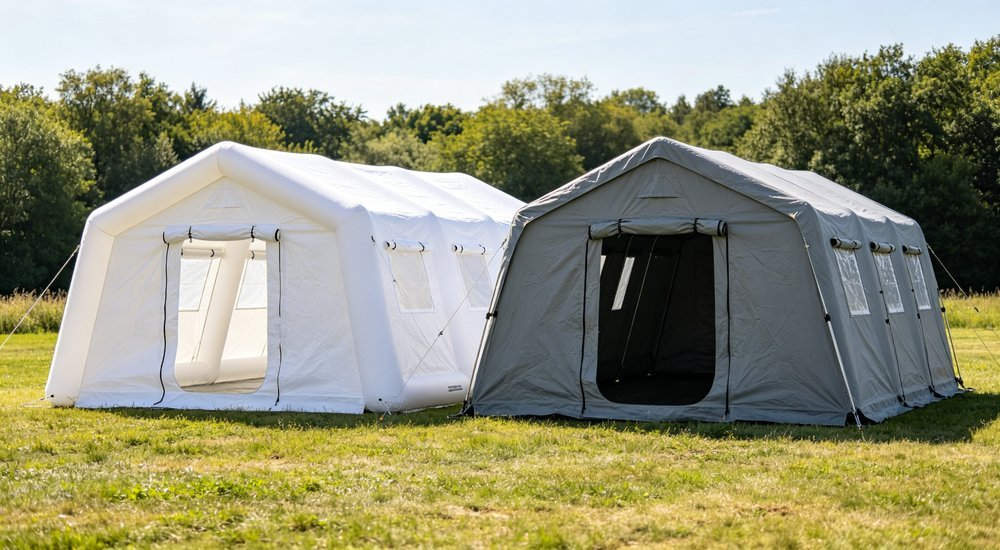
A medical inflatable tent looks similar to a regular inflatable shelter from the outside, but the internal specification is a different product category. Camping tents are built for sleeping and light weather protection. Medical tents are built for infection control, clinical equipment, and repeated disinfection.
Key differences you cannot see from photos: As a leading tent factory,
A regular inflatable tent may work as a waiting area or storage space at a medical camp, but it should not be used as a consultation room, isolation ward, or operating area unless it has the full medical configuration. Using a general shelter for clinical work introduces infection control and equipment safety risks that are hard to justify.
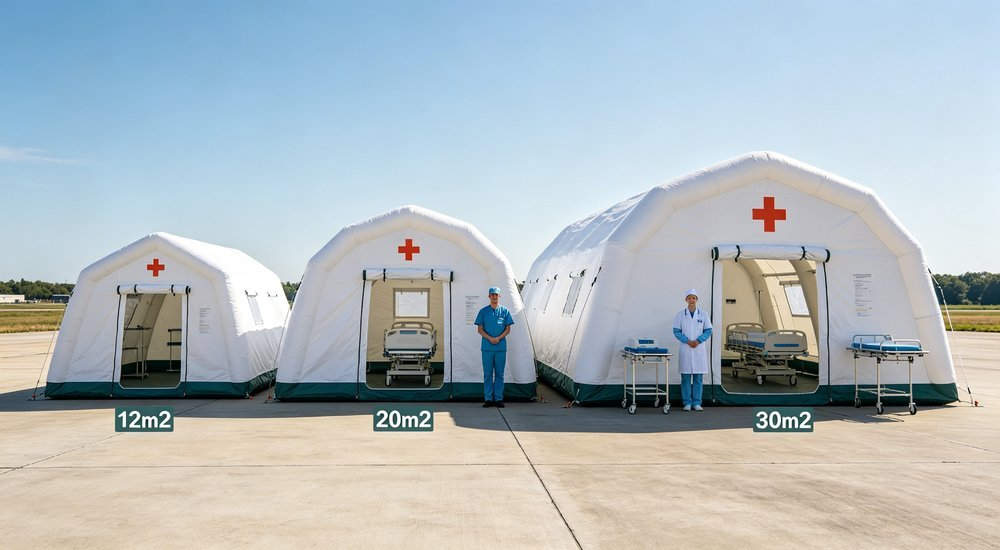
External dimensions do not equal clinical working space. Air beams, equipment, beds, corridors, and airlock doors all take room. For a medical tent, the layout is more important than the square meter number. A 20m² open space feels large until you add a patient bed, a monitor cart, an oxygen cylinder stand, and a buffer corridor.
Start with the patient flow. Do patients enter from one end and exit from the other? Where does staff gown and doff? Where do clean supplies enter? Draw the path on paper first. Then ask the supplier which tent size can physically contain that path. A single-zone tent can handle 15-20m² for triage. A three-zone system needs 40m² minimum to keep clean, buffer, and contaminated areas separate without crowding.
Also check door width for stretchers and medical carts. A 90cm door may look fine for people, but a stretcher with equipment needs 120cm. Ceiling height matters too — medical teams in full PPE plus hanging monitors need at least 2.4m internal height.
Rule of thumb: 15-20m² fits one consultation or triage room. 20-30m² fits a single isolation ward with 4-6 beds. 40-60m² supports a three-zone field hospital. Go bigger only when the patient flow and equipment list require it — a larger tent costs more to heat, filter, and transport. We offer disaster relief tent solutions for global buyers. We offer tent manufacturer solutions for global buyers.
Medical-grade inflatable structures differ significantly from consumer camping tents in durability, infection control and rapid deployment capability. As a leading tent supplier.
Both are air-beam structures. But the difference between a $2,500 regular shelter and a $12,000 medical system is not in the shape — it is in the airflow, filtration, zoning, and equipment interfaces. The table below shows the real differences.
This comparison table provides essential specifications for procurement evaluation. Buyers use this data to compare configurations, assess material quality, and calculate total project costs. As a professional tent manufacturer with extensive export experience, we ensure all parameters meet international standards and field deployment requirements. This information is particularly valuable for government procurement teams, NGO aid organizations, and international relief agencies evaluating bulk supply contracts.
|
Factor |
Medical Inflatable Tent |
Regular Inflatable Tent |
|
Fabric specification |
Anti-bacterial PVC 280-420g/m², PU5000mm, flame retardant |
Standard PVC 280-350g/m², PU3000mm |
|
Seam construction |
Fully welded, air-sealed, wipe-clean |
Welded but not sealed for pressure differentials |
|
Airflow system |
Negative pressure -15 to -30 Pa, HEPA H13/H14, 6-12 air changes/hr |
Natural ventilation or simple exhaust fan |
|
Zone design |
Three-zone layout: clean / buffer / contaminated, unidirectional airflow |
Single open space, no zoning |
|
Pressure monitoring |
Digital manometer with audible alarm, continuous display |
Not included |
|
Medical equipment interfaces |
Oxygen outlets, monitor mounting points, UPS power, surgical light points, cable glands |
No dedicated medical interfaces |
|
Floor |
Welded non-porous PVC floor, disinfectant-compatible |
Removable groundsheet |
|
Power demand |
3-10 kW (HVAC, exhaust, lighting, equipment, UPS) |
0.5-1.5 kW (pump, lighting, fans) |
|
Price range |
$2,500 - $12,000+ |
$800 - $5,000 |
|
Typical certifications |
CE, ISO 9001, ISO 13485 (if applicable), NFPA 701, CPAI-84 |
CE, ISO 9001, CPAI-84 |
The takeaway: a regular inflatable tent costs less and sets up fast, but it cannot maintain a controlled clinical environment. If your task involves patients, infection control, or medical equipment, the medical specification is not optional — it is the minimum requirement for a safe working space.
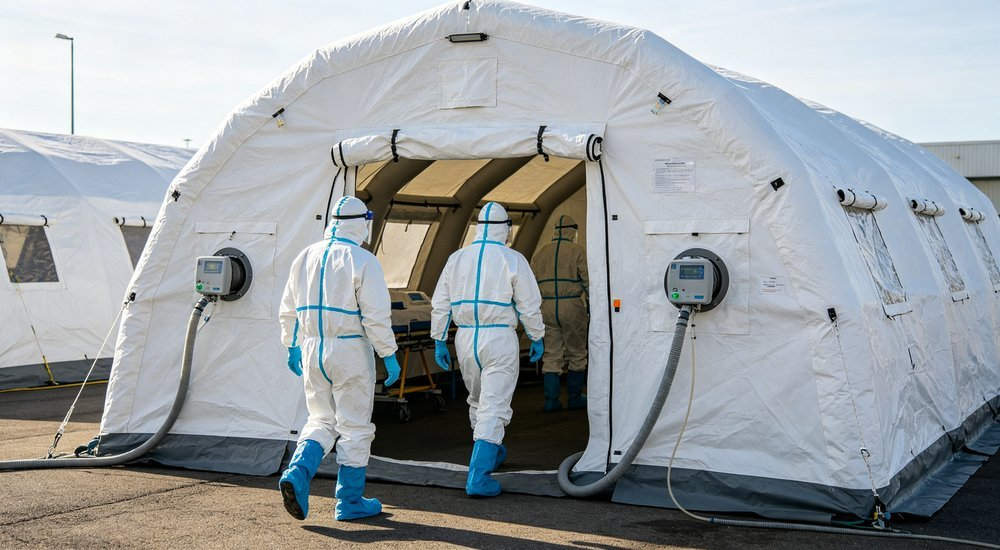
Proper infection control zoning prevents cross-contamination between patient areas and clean medical supply zones. As a leading OEM tent,
Proper storage and maintenance extend the service life of medical inflatable tents.
Proper storage and maintenance extend the service life of medical inflatable tents.
Medical inflatable tents use a three-zone layout to prevent cross-contamination. This is the single most important design feature that separates a clinical shelter from a regular tent. Understanding the airflow direction is essential for anyone buying or operating one.
Clean zone (left side): This is the sterile and staff area. It includes the supply room, staff changing area, and clean storage. Air flows IN from outside through HEPA-filtered supply units, keeping this zone at the highest positive pressure. No patients enter this area directly.
Semi-contaminated / buffer zone (center): This is the transition corridor. It includes handwashing stations, gowning and doffing areas, and airlock doors. Pressure here is intermediate — lower than the clean zone but higher than the contaminated zone. Staff pass through here when moving from clean to dirty areas, and patients pass through when entering or leaving.
Contaminated zone (right side): This is the patient and treatment area. It includes patient beds, examination tables, and the isolation ward. Exhaust air is pulled OUT through HEPA H13 or H14 filters and discharged safely. This zone runs at negative pressure (-15 to -30 Pa relative to the buffer zone), so contaminated air never leaks back toward the clean side.
The golden rule: air always flows from clean to contaminated. Doors between zones are arranged so that staff and patients follow one-way paths. This is why a single open-room tent cannot function as an isolation unit — there is no way to control the airflow direction.
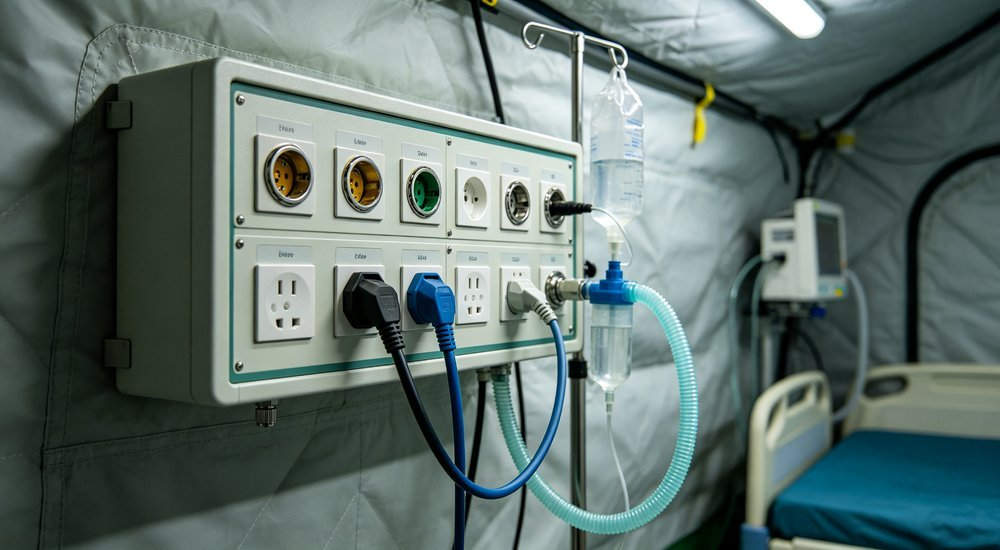
A medical tent is only as useful as the equipment it supports. Unlike a general shelter, a clinical tent needs pre-engineered interfaces for power, gas, and device mounting. Plan these before you select a size.
Electrical power: A basic consultation tent needs about 3 kW (lighting, exhaust fan, small devices). A negative-pressure isolation tent with HVAC needs 5-7 kW. A full field hospital or surgery unit can require 8-10 kW. Plan for shore power or a generator, plus a UPS backup (typically 1-3 kW) for patient monitors, ventilators, and critical alarms. The supplier should provide a power load calculation for the confirmed configuration.
Medical gas: Oxygen cylinder manifolds with wall outlets are standard. The supplier can include mounting brackets, pressure regulators, and quick-connect outlets. Confirm the number of outlets needed and whether you also want medical air or vacuum lines.
Equipment mounting points: Reinforced roof points for patient monitors, infusion pumps, and LED examination lights. Wall rails for hanging supplies. Floor anchors for securing the operating table and beds. Each mounting point has a rated load — ask for the weight capacity.
UPS and backup power: For any tent used for patient monitoring or life support, a UPS unit is essential. It bridges the gap when main power fails or the generator switches. The UPS should cover at least 15-30 minutes of critical equipment runtime.
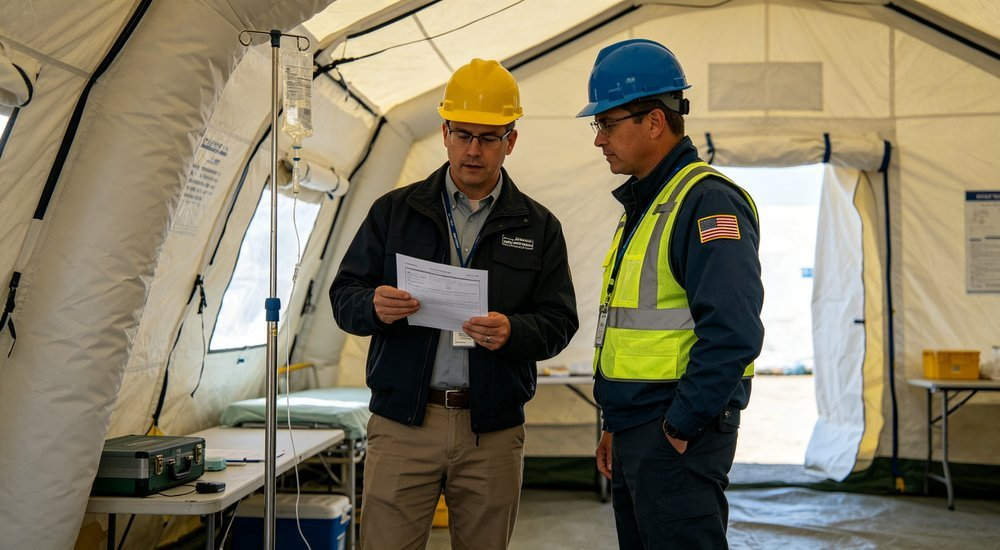
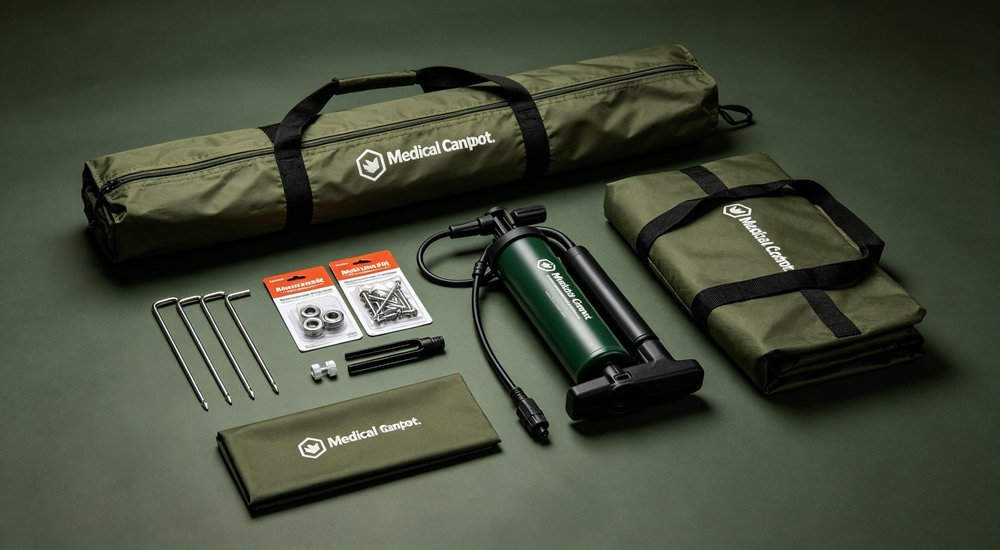
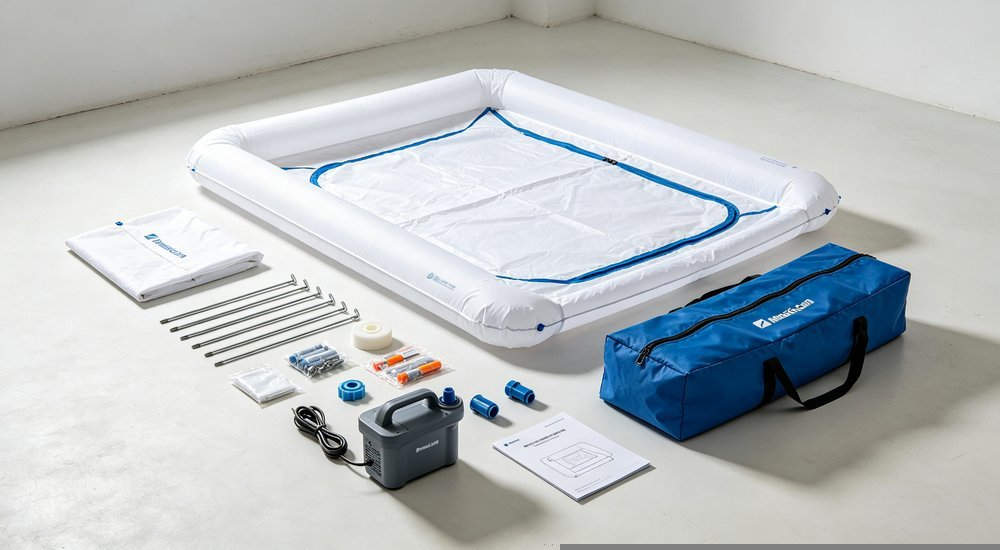
When you order a medical emergency inflatable tent, the quotation should cover more than the tent shell. A complete medical configuration typically includes:
This comparison table provides essential specifications for procurement evaluation. Buyers use this data to compare configurations, assess material quality, and calculate total project costs. As a professional tent manufacturer with extensive export experience, we ensure all parameters meet international standards and field deployment requirements. This information is particularly valuable for government procurement teams, NGO aid organizations, and international relief agencies evaluating bulk supply
Understanding emergency medical tent requires careful analysis of the parameters below. This table helps procurement officers compare tent manufacturer solutions, identify cost-saving opportunities, and select configurations that match their operational needs. We manufacture OEM medical tent with strict quality control at every production stage. This information is particularly valuable for government procurement teams, NGO aid organizations, and international relief agencies evaluating bulk supply contracts.
|
Category |
Included Items |
Notes |
|
Tent structure |
Air-beam body, anti-bacterial PVC cover, welded floor, doors with airlock frames |
Size 20-60m² depending on configuration |
|
Air filtration system |
HEPA H13 or H14 filter housing, supply fan, exhaust fan, ducting |
H13 standard, H14 upgrade available |
|
Pressure control |
Digital manometer, pressure differential alarm, variable-speed fan controller |
Target: -15 to -30 Pa in contaminated zone |
|
Power system |
Distribution panel, medical-grade outlets, cable glands, UPS (optional) |
3-10 kW depending on configuration |
|
Climate control |
HVAC unit (heating/cooling), insulated ducting, temperature sensor |
Essential for clinical comfort and equipment reliability |
|
Medical interfaces |
Oxygen outlet points, monitor mounting rails, equipment shelves |
Number of outlets and points per project |
|
Setup equipment |
Electric pump (1900W), repair kit, anchoring kit, storage bags |
Manual pump backup recommended |
Always ask for a line-item quotation. "Complete medical tent" without a component list means you do not know whether the HEPA filter, pressure monitor, or UPS is included. A missing filter housing can delay deployment by weeks.
A good medical tent inquiry gives the supplier enough information to propose the right configuration. State the following clearly: As a leading custom tent,
Request: a suggested layout drawing, internal dimensions, component list, power load calculation, airflow diagram, available certificates, and packing information. MOQ, lead time, and pricing depend entirely on the confirmed configuration.
A good supplier reply starts with the exact configuration for your medical task — not a generic price. It should specify the tent size, air-beam arrangement, three-zone layout, HEPA grade, pressure target, and equipment interfaces. Every recommendation traces back to your inquiry.
The reply separates included items from optional items. HEPA filters, pressure monitors, UPS units, oxygen outlets, and HVAC each get their own line. If a quotation says "complete medical system" without a component list, you cannot compare it fairly with another quotation that lists everything.
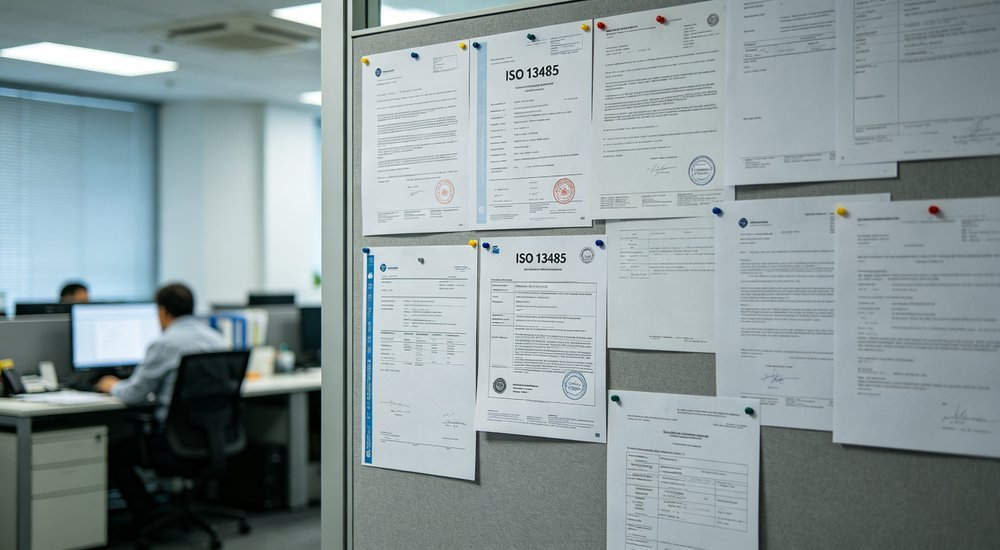
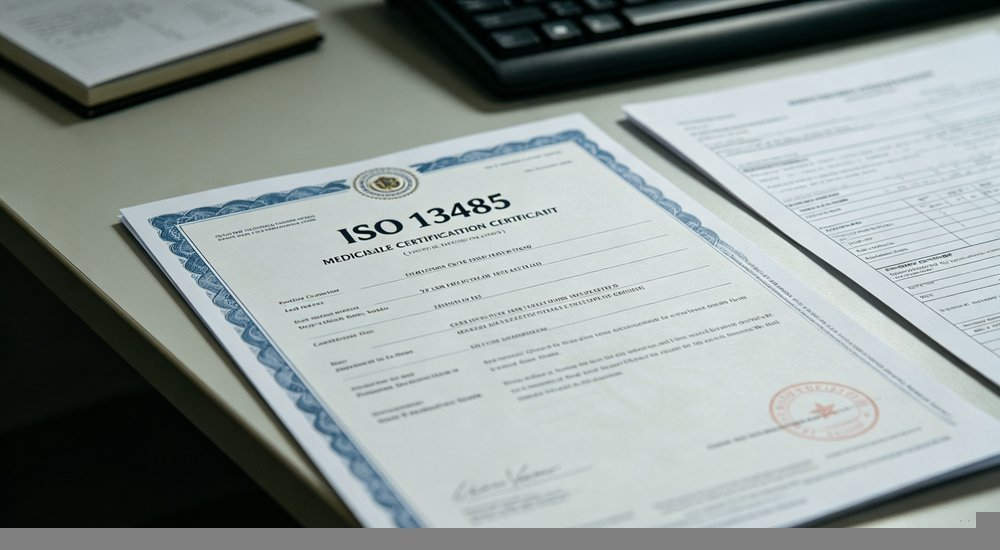
Documents should state which configuration they cover. A CE certificate applies to the inflatable structure, not the medical electrical system. An ISO 13485 reference (if claimed) must identify which components fall under it. Packing info should show how many bags or cartons the system ships in, with dimensions and weights per package.
This comparison table provides essential specifications for procurement evaluation. Buyers use this data to compare configurations, assess material quality, and calculate total project costs. As a professional tent manufacturer with extensive export experience, we ensure all parameters meet international standards and field deployment requirements. This information is particularly valuable for government procurement teams, NGO aid organizations, and international relief agencies evaluating bulk supply contracts
Medical inflatable tent pricing depends heavily on the configuration. A basic consultation tent costs a fraction of what a negative-pressure isolation or field surgery system costs. The table below gives indicative ranges.
This specification table provides a comprehensive overview of tent manufacturer. Organizations use this data to benchmark OEM medical tent suppliers, evaluate material quality, and plan logistics for large-scale deployments. As a direct bulk medical shelter, we offer transparent pricing and flexible customization for every order size. This information is particularly valuable for government procurement teams, NGO aid organizations, and international relief agencies evaluating bulk supply contracts.
|
Configuration |
Size |
Key Features |
Price Range (USD) |
|
Basic consultation / triage |
15-20m² |
Anti-bacterial PVC, electric pump, basic ventilation, 3kW power |
$2,500 - $4,000 |
|
Negative pressure isolation |
20-30m² |
HEPA H13 supply + exhaust, -15 to -30 Pa, pressure alarm, 5-7kW power |
$6,000 - $9,000 |
|
Field hospital / 3-zone |
40-60m² |
Three-zone layout, HEPA H13/H14, medical gas outlets, UPS, 8-10kW power |
$9,000 - $15,000+ |
|
Field surgery / OR tent |
20-30m² (OR room) |
HEPA H14, laminar airflow, surgical pendants, surgical lighting, UPS |
$12,000 - $20,000+ |
* Prices are indicative ranges for standard configurations. Custom sizes, special medical equipment integration, and branding add cost. Always compare complete system quotations including filters, power, and HVAC — not just the tent shell.
This comparison table provides essential specifications for procurement evaluation. Buyers use this data to compare configurations, assess material quality, and calculate total project costs. As a professional tent manufacturer with extensive export experience, we ensure all parameters meet international standards and field deployment requirements. This information is particularly valuable for government procurement teams, NGO aid organizations, and international relief agencies evaluating bulk supply contracts.
This comparison table provides essential specifications for procurement evaluation. Buyers use this data to compare configurations, assess material quality, and calculate total project costs. As a professional tent manufacturer with extensive export experience, we ensure all parameters meet international standards and field deployment requirements. This information is particularly valuable for government procurement teams, NGO aid organizations, and international relief agencies evaluating bulk supply contracts.
The data below summarizes essential metrics for OEM medical tent. Procurement teams rely on this information to compare bulk medical shelter performance, assess durability ratings, and calculate total project budgets. Our factory produces China tent factory with consistent quality and reliable delivery timelines for international clients. This information is particularly valuable for government procurement teams, NGO aid organizations, and international relief agencies evaluating bulk supply contracts.
|
Configuration |
MOQ |
Lead Time |
Notes |
|
Standard consultation tent (15-20m²) |
1-5 units |
25-35 days |
Stock anti-bacterial PVC, standard HEPA units |
|
Negative pressure isolation tent |
1-5 units |
30-45 days |
HEPA housings and pressure controllers sourced separately |
|
Field hospital multi-zone system |
1-3 units |
45-60 days |
Custom layout, medical gas, UPS integration |
|
Custom color / branding |
10+ units |
40-55 days |
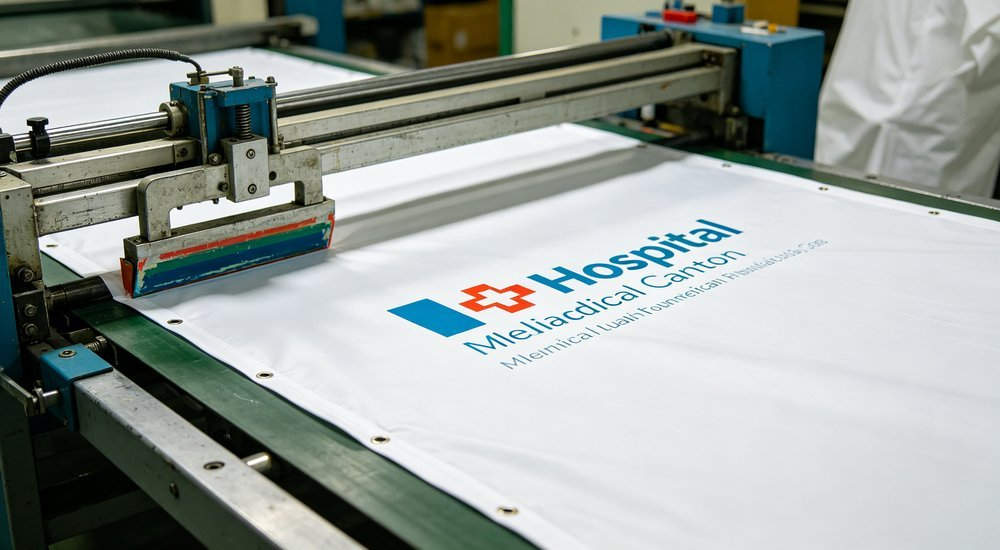
Custom PVC production and printing |
This comparison helps buyers understand the differences between bulk medical shelter configurations. The table covers key specifications that determine China tent factory suitability for different emergency scenarios. As a professional healthcare tent supplier, we provide detailed documentation and sample validation for every product line we manufacture. This information is particularly valuable for government procurement teams, NGO aid organizations, and international relief agencies evaluating bulk supply contracts.
|
Configuration |
Packed Volume |
Weight |
Units per 20ft Container |
Units per 40ft Container |
|
Basic 20m² consultation |
1.5-2.0m³ |
120-160kg |
18-22 units |
40-50 units |
|
30m² isolation + HEPA |
2.5-3.5m³ |
200-280kg |
10-14 units |
25-32 units |
|
40-60m² field hospital (kit) |
5-8m³ (multi-bag) |
400-700kg |
4-6 units |
10-14 units |
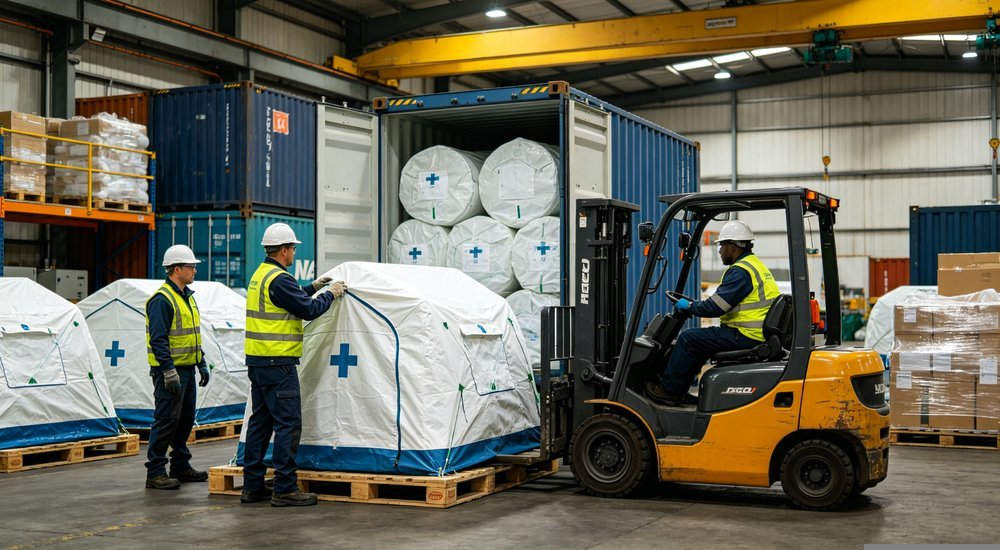
* Each system is packed in multiple labeled bags/cartons: tent body, air beams, HEPA units, power panels, pump, and accessories. A detailed packing list accompanies every order. HEPA filters are packed in sealed plastic to protect media during transit.
Standard configurations can be customized based on specific operational requirements. As a leading bulk tent,
Each configuration is designed for specific medical response scenarios.

Medical inflatable tents must meet both structural safety standards and medical device quality expectations. We verify the following: As a leading tent export,
This comparison table provides essential specifications for procurement evaluation. Buyers use this data to compare configurations, assess material quality, and calculate total project costs. As a professional tent manufacturer with extensive export experience, we ensure all parameters meet international standards and field deployment requirements. This information is particularly valuable for government procurement teams, NGO aid organizations, and international relief agencies evaluating bulk supply contracts
This comparison table outlines key specifications for China tent factory. Procurement teams use this data to evaluate healthcare tent supplier options, compare pricing structures, and verify compliance with international standards. As an experienced medical inflatable tent, we ensure every parameter meets field deployment requirements for emergency response operations worldwide. This information is particularly valuable for government procurement teams, NGO aid organizations, and international relief agencies evaluating bulk supply contracts.
|
Certification / Test |
Scope |
Details |
|
CE certification |
Inflatable structure safety |
EU market compliance for air-beam shelters |
|
ISO 9001 |
Factory quality management |
Controlled production and inspection process |
|
ISO 13485 (where applicable) |
Medical device quality system |
Applied to HEPA housings and electrical medical components when configured |
|
NFPA 701 / CPAI-84 |
Fabric fire retardancy |
Test reports for anti-bacterial PVC tent material |
|
Anti-bacterial fabric test |
Microbial resistance |
Test report for coating effectiveness |
|
Air retention test |
24-hour pressure loss |
Each unit tested before packing |
|
HEPA filter efficiency |
H13 / H14 particulate capture |
99.95% / 99.995% at 0.3 microns (manufacturer spec) |
Standard medical tent dimensions include 12m², 20m², 30m² and 50m² configurations. Medical tent setup time ranges from 5-15 minutes for inflatable models versus 30-60 minutes for traditional frame tents.
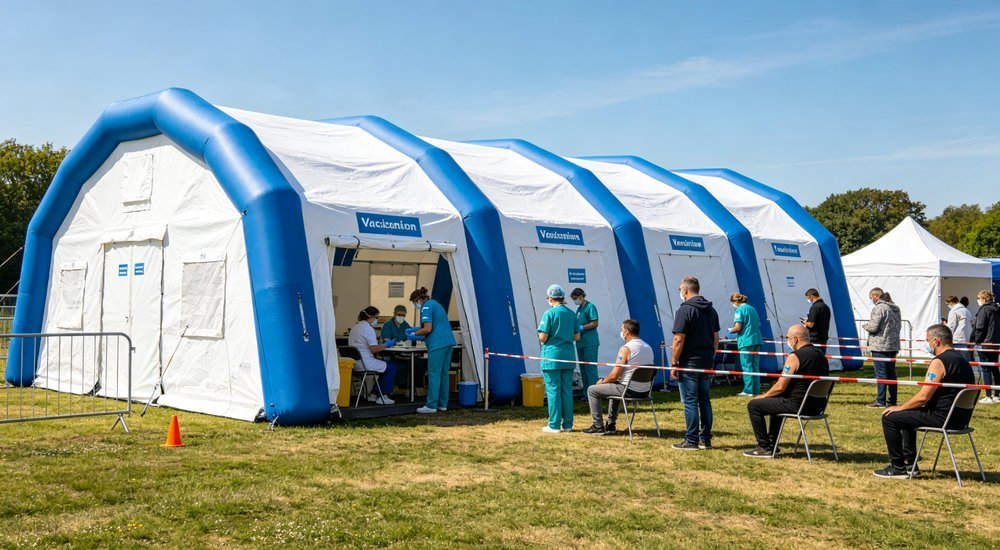
Medical tent infection control incorporates sealed seams, antimicrobial fabrics and three-zone design. Medical tent negative pressure systems exhaust HEPA-filtered air from isolation sections, making them suitable for pandemic response and quarantine operations.
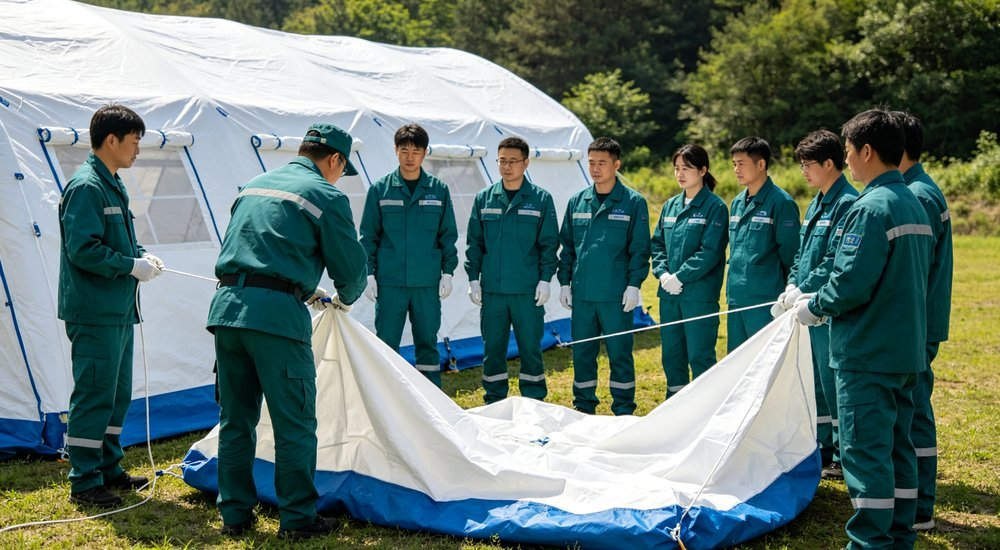
Medical inflatable tents are engineered to meet the strictest infection control and patient safety standards required by healthcare institutions worldwide.
Medical tent flooring features insulated waterproof ground sheets. Medical tent lighting includes LED strips and exam lights. Medical tent power supply panels offer hospital-grade outlets, medical tent oxygen port connections and medical tent generator compatibility.
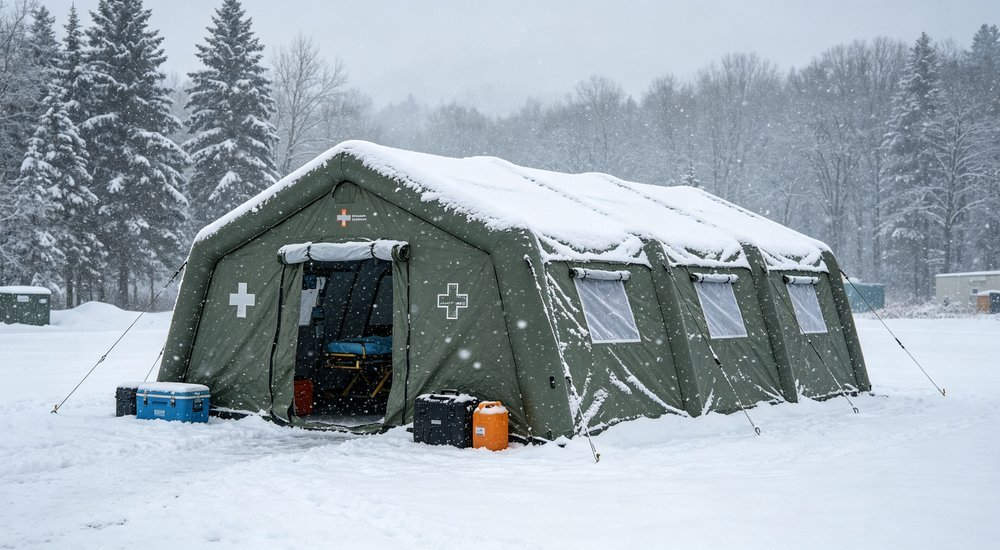
Medical tent winterized packages include medical tent insulated liners, medical tent heating systems and medical tent snow load rated structures rated for 25-50kg/m² snow loading.
All fabrics meet medical tent fire retardant standards (CPAI-84, EN 13501), medical tent waterproof ratings of PU5000-8000mm and medical tent UV resistant treatment for 500+ hours of sun exposure.
Yes, medical tent modular systems connect via sealed corridors to create larger field hospitals. Medical tent connectable and medical tent expandable configurations support triage, outpatient, emergency room and ICU zones.
We provide medical tent OEM manufacturing, medical tent ODM customization and medical tent private label services including medical tent custom logo printing, custom colors and branded packaging.
Medical tent MOQ starts at 10 units for standard models. Medical tent lead time is 15-30 days for production. Medical tent bulk order discounts apply for orders over 50 units with medical tent shipping by sea or air freight.
Standard medical tent warranty covers 2-3 years against manufacturing defects. Medical tent after sales includes medical tent repair kit, medical tent spare parts and medical tent training videos for deployment teams.
Proper medical tent maintenance includes cleaning, drying and medical tent sterilization after each use. Medical tent storage requires cool, dry conditions. Medical tent lifespan averages 5-8 years with regular maintenance and proper medical tent storage practices.
Medical tent safety standards include wind load ratings of 80-100km/h, medical tent earthquake resistant design and compliance with medical tent regulations for ISO 13485, CE marking and FDA registration where applicable.
We supply medical tent humanitarian aid organizations, medical tent UNICEF procurement programs and medical tent Red Cross emergency response missions worldwide, with experience in refugee camp and disaster response deployments.
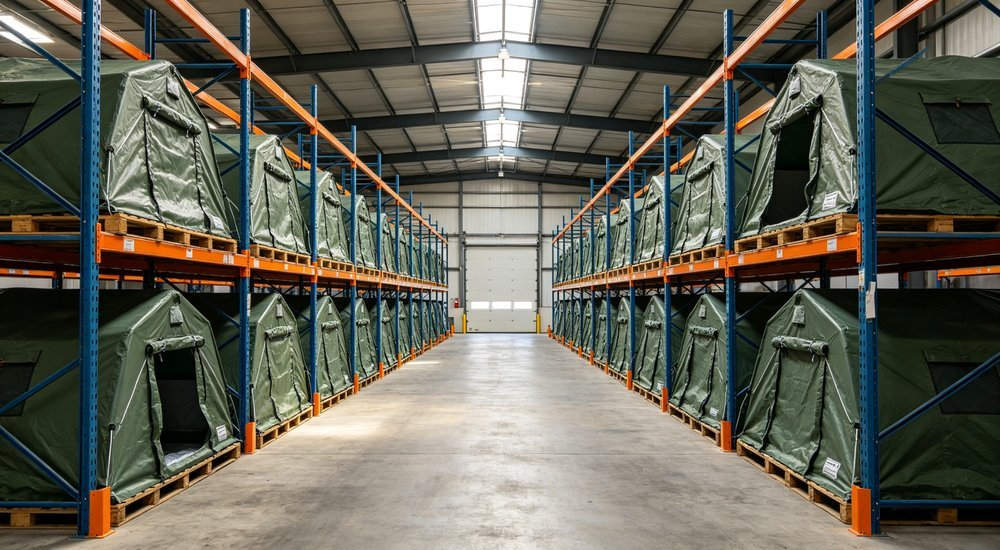
A mobile medical tent can be transported by pickup truck or helicopter to remote disaster zones within hours.
Modular medical tent systems can be connected to create larger field hospitals with specialized zones.
Negative pressure means the contaminated zone has lower air pressure than adjacent cleaner areas. The system exhausts more air out than it supplies in through HEPA-filtered supply units. The target is typically -15 to -30 Pa relative to the buffer zone. A digital manometer continuously monitors the differential and triggers an audible alarm if it drops. This ensures contaminated air flows outward through the HEPA exhaust filter, not into cleaner zones. Without a controlled exhaust system and pressure monitoring, the tent cannot guarantee isolation performance.
Standard configurations use HEPA H13 filters, rated at 99.95% efficiency at 0.3 microns. Upgraded medical-grade options use HEPA H14 at 99.995% efficiency. Filtration applies to both supply air (cleaning incoming air) and exhaust air (capturing contaminants before discharge). Air-change rates range from 6 to 12 per hour depending on the zone and fan capacity. Ask for the filter grade, airflow rate in CFM, and replacement schedule.
Only in a purpose-built field surgery configuration. A standard consultation or isolation tent is not suitable for invasive procedures. A field surgery tent requires: HEPA H14 filtration with directional or laminar airflow, surgical lighting pendants, medical gas outlets (oxygen, vacuum), UPS-backed power, a sterile draping system, and a clean-zone layout. Expect a 20-30m² dedicated OR room as part of a larger field hospital complex. A basic 20m² inflatable tent is not adequate for surgery.
A medical-grade inflatable tent with anti-bacterial coating, sealed seams, HEPA-filtered supply air, and controlled pressure differentials can approximate a clinical clean zone. However, it does not automatically equal an ISO 14644 cleanroom class. Ask the supplier for the tested particulate level, air-change rate, and whether they have validated the configuration. For operating theater use, a higher specification with laminar airflow and H14 filters is required.
Power demand ranges from 3 kW for a basic consultation tent (lighting, ventilation, small devices) to 10 kW for a full field hospital including HVAC, negative-pressure exhaust, surgical lighting, UPS, and medical devices. A 20m² triage tent typically needs 3-5 kW. Plan for shore power or a generator, plus a UPS backup for monitoring and life-support equipment. The supplier should provide a power load list for your confirmed configuration.

A regular inflatable tent provides shelter only. A medical-grade tent adds anti-bacterial PVC fabric, sealed seams for pressure differential, a three-zone layout (clean / buffer / contaminated), negative-pressure exhaust with HEPA H13/H14 filtration, pressure monitoring and alarms, medical equipment mounting points, wipe-clean welded flooring, and medical-grade power distribution. The cost difference is significant — typically $2,500 for a basic medical unit versus $800 for a regular shelter — but the clinical safety justification is clear.
The clean zone (staff, sterile supplies) is at the highest positive pressure. The semi-contaminated buffer zone (gowning, handwashing) is at intermediate pressure. The contaminated zone (patients, isolation) runs at negative pressure. Air flows unidirectionally from clean to contaminated — it never reverses. Staff and patients follow separate entry and exit paths. This prevents cross-contamination. A single open-room tent cannot provide this level of infection control because there is no way to zone the airflow.
Medical configurations can include a field operating table, oxygen cylinder manifolds with wall outlets, patient monitor hanging points, infusion pump mounts, UPS power outlets, LED surgical or examination lights, and refrigerated medication boxes. The tent should have reinforced roof points for mounting, cable glands for power and gas lines, and a disinfectant-compatible floor. Confirm the load rating of each mounting point and whether gas lines are included in the quotation.
A 20-30m² single-zone medical tent takes 20-30 minutes with 4-6 people using an electric pump. A multi-zone modular field hospital (40-60m² with negative pressure, HEPA, and equipment) takes 2-4 hours including equipment installation, filter housing, power connection, and pressure balancing. Always ask whether the quoted setup time includes equipment commissioning, not just inflating the tent shell.
At minimum: CE certification for the inflatable structure, ISO 9001 for factory quality, and fire-retardant fabric standards such as NFPA 701 or CPAI-84. For medical configurations, ask whether ISO 13485 quality management applies to the medical components (HEPA housings, pressure monitors, electrical panels). The anti-bacterial coating and PU waterproofing should have test reports. Always request actual certificate numbers and expiry dates — do not accept verbal claims.
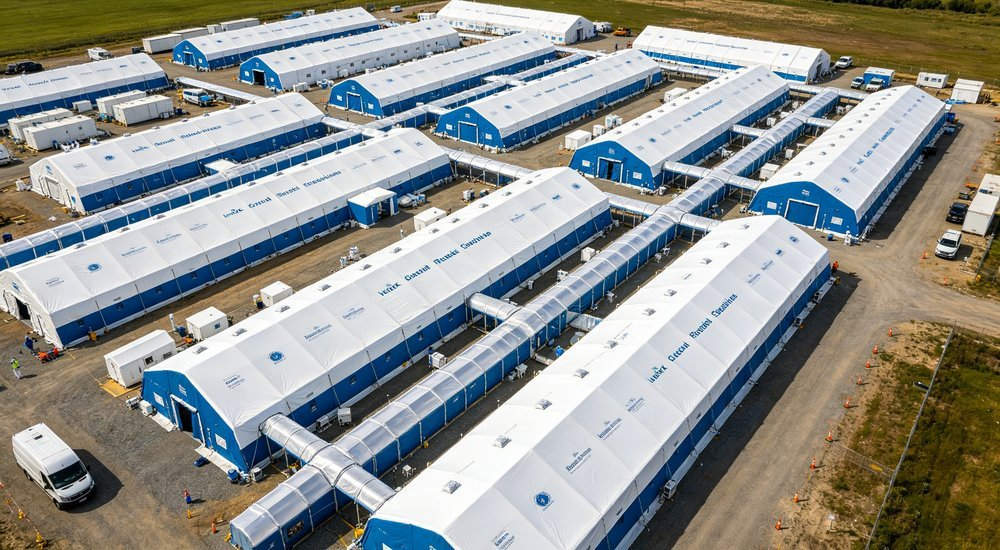
Prices range from $2,500 for a basic 20m² consultation or triage tent, to $6,000-$9,000 for a negative-pressure isolation tent with HEPA H13 filtration, to $12,000+ for a complete modular field hospital with three zones, surgical lighting, and equipment interfaces. Prices depend on size, filtration grade, negative-pressure system, HVAC, and included medical equipment. Always compare complete system quotations.
Standard medical configurations typically have an MOQ of 1-5 units. Custom layouts or specific medical equipment integration usually require 5-20 units. Lead time is 25-35 days for standard configurations and 40-60 days for fully customized field hospital systems. Negative-pressure systems and HEPA filter housings add lead time due to component sourcing. Confirm these details in your formal inquiry.
Looking for tent factory? Contact us for factory-direct pricing. As a leading China tent,
Looking for tent supplier? Contact us for factory-direct pricing.
Confirm the right negative pressure and HEPA configuration for your project
Contact us today for factory-direct pricing and custom solutions.
 |

|
The emergency clinic tent configuration provides a fully functional temporary healthcare facility, complete with patient consultation areas, pharmacy storage, and administrative workspace. This makes it ideal for remote community health programs and disaster zone medical outreach.
Дружественные ссылки :
авторское право © Custom Disaster - Relief Bedding: Tents, Sleeping Bags, Blankets Все права защищены
профессиональная команда для обслуживания !